
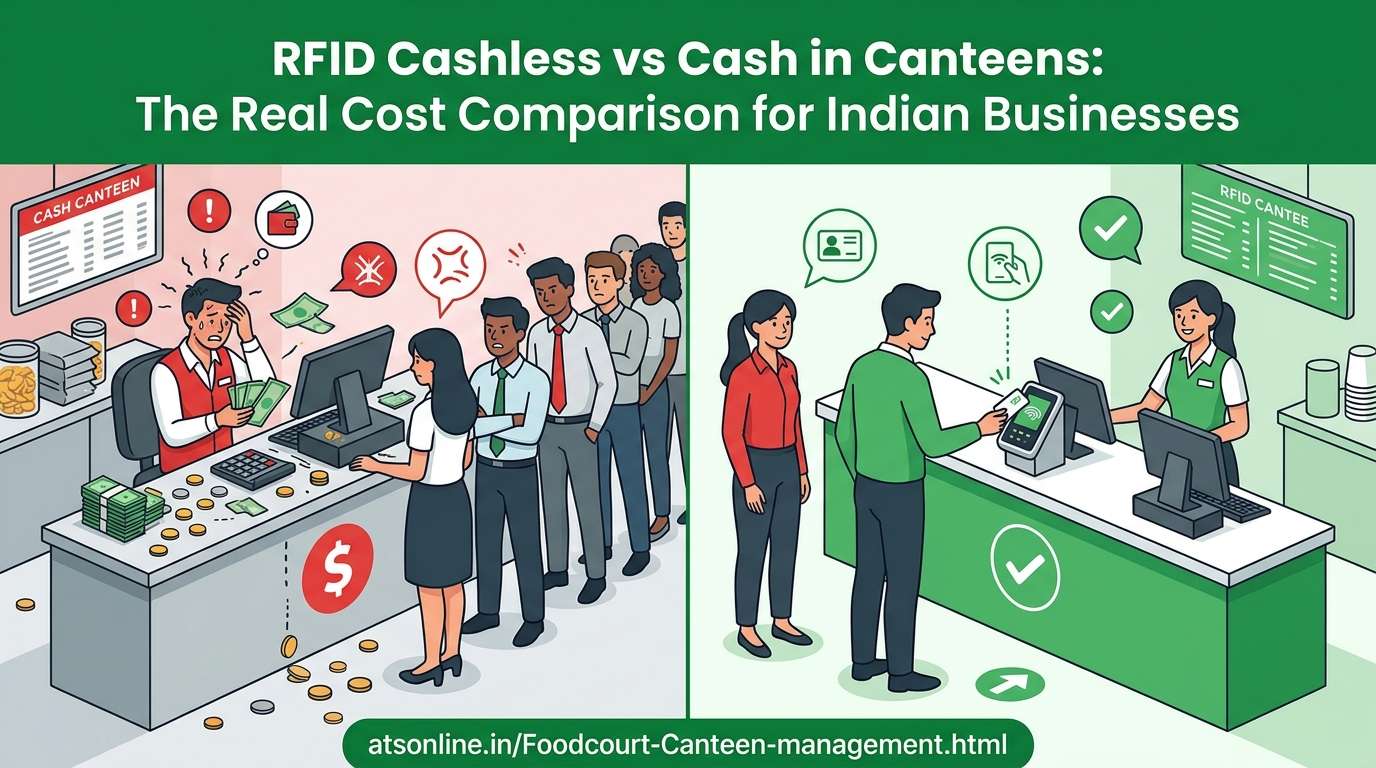
Is RFID cashless worth it for your canteen management ? We break down the real cost comparison — cash handling losses, reconciliation time, and RFID savings.
When corporate cafeteria managers and food court operators in India consider switching from cash to RFID cashless billing, one question comes up immediately: “Is it actually worth the investment?”
The honest answer requires going beyond the software cost and looking at the full picture — what cash is costing you right now, and what RFID saves you over time. Most businesses that do this analysis find that their current cash system is far more expensive than they realised.
This post breaks down the real numbers. We compare RFID prepaid card billing vs cash across every dimension that affects your bottom line — transaction speed, staff costs, revenue leakage, reconciliation time, and customer experience. The comparison is based on data from ATS installations across Indian corporate canteens, food courts, schools, and event venues.
The Hidden Costs of Running a Cash Canteen
Most canteen managers think of cash as free — there is no software cost, no setup fee, no hardware to buy. This is the wrong way to think about it. Cash has very real costs, they are just harder to see because they are distributed across multiple loss points:
1. Cash Handling Time
At a busy canteen counter, a cash transaction takes 20–45 seconds — more if the customer does not have exact change. At 300 transactions a day, that is 100–225 minutes of transaction time per day, per counter. An RFID tap takes under 2 seconds — the same 300 transactions take under 10 minutes of transaction time. The time saving alone translates directly into shorter queues and higher throughput during the 45-minute lunch rush.
2. Cash Counting and Reconciliation
At end of day, cash must be counted, verified against the billing record, and reconciled. In a canteen processing ₹30,000–₹80,000 per day across multiple counters, this takes 45–90 minutes per day — and still rarely matches exactly. That reconciliation time is staff time that is paid for but adds no operational value. With RFID, the reconciliation report is generated in under 30 seconds. Automatically. Exactly.
3. Cash Pilferage and Billing Errors
This is the most significant hidden cost — and the most uncomfortable to acknowledge. In a busy canteen with multiple staff members handling cash, pilferage of ₹500–₹3,000 per day is common, particularly across shift changes and during peak hours when supervision is reduced. Billing errors — wrong change given, items billed incorrectly — add another layer of loss. With RFID, there is no cash at the counter to pilfer and no change to miscalculate.
4. Pre-Printed Coupon or Token Management
Many canteens use pre-printed coupon booklets or paper tokens as a partial cashless solution. These have their own costs: design, printing, distribution, collection, and manual reconciliation. Duplicate or fake coupons appear at events. Unused coupons represent a reconciliation liability. RFID replaces all of this with a digital system that has zero printing cost and zero fraud risk.
5. Subsidy Management Complexity
Many corporate canteens provide subsidised meals — the company pays ₹30 per meal and the employee pays ₹20. Managing this subsidy with cash requires manual vouchers, complex settlement between HR and the canteen vendor, and monthly reconciliation that frequently generates disputes. RFID systems automate the subsidy — the employee pays from their card, the company subsidy is deducted automatically, and the settlement report is generated without any manual intervention.
The Full Cost Comparison: Cash vs RFID
Here is the side-by-side comparison across every dimension that affects a canteen’s operations and profitability:
| Cost / Factor | Cash System | RFID Cashless System |
| Transaction time | 20–45 seconds per customer | Under 2 seconds per tap |
| Peak hour throughput | Low — cash slows the queue | High — tap-and-go service |
| Daily reconciliation | 45–90 min / day — manual, error-prone | Under 1 min — automatic report |
| Revenue pilferage | ₹500–₹3,000/day (conservative est.) | Near zero — all transactions logged |
| Billing error rate | 3–8% of transactions | Zero — system calculates exactly |
| Subsidy management | Manual vouchers — monthly disputes | Automated — no disputes |
| Coupon / token printing | ₹5–₹15 per booklet, design + print | Zero — fully digital |
| Staff time on cash duties | 1–2 hours/day counting + verification | None — reports are instant |
| Report availability | End of day, manual, often incomplete | Real-time, accurate, exportable |
| Customer queue experience | Long at peak — frustration common | Short — high satisfaction |
| Lost revenue on slow service | Customers leave the queue | Fast service — all orders captured |
| Multi-counter settlement | Counter-wise cash reconciliation — slow | Automatic counter-wise report |
| Audit trail | None — cash is untraceable | Every transaction timestamped |
| System setup cost | Zero upfront | ₹48,000 one-time (ATS software) |
| Ongoing running cost | Hidden losses (see above) | ₹0 — software already paid for |
Putting Numbers to It: A Real-World Calculation
Let us run the numbers for a typical mid-sized corporate canteen in India — 3 counters, 400 transactions per day, serving 300–400 employees at lunch:
| Monthly Cost Category | Cash System (Monthly) | RFID System (Monthly) |
| Revenue pilferage (conservative ₹800/day) | ₹20,000 | ₹0 |
| Billing error losses (3% on ₹50,000/day) | ₹37,500 | ₹0 |
| Reconciliation staff time (1.5 hrs × ₹150) | ₹3,375 | ₹0 |
| Coupon / token printing (if applicable) | ₹3,000 | ₹0 |
| RFID software cost (₹48,000 ÷ 36 months) | ₹0 | ₹1,333 |
| RFID hardware upkeep (est.) | ₹0 | ₹500 |
| TOTAL MONTHLY COST | ₹63,875 / month | ₹1,833 / month |
| Annual saving with RFID | ₹74,448 per year |
| These are conservative estimates. Many canteen managers who have switched to RFID report even higher savings — particularly in larger canteens where pilferage and reconciliation losses are proportionally greater. The ₹48,000 software investment pays for itself within the first month for most mid-sized canteens. |
You can reach us by phone at +91 9810078010 or by email at ats.fnb@gmail.com. Thank you for your interest in our services.
Beyond Cost: What Cash Cannot Give You
The financial comparison above focuses on what cash costs you. But there is another dimension to consider: what cash systems simply cannot deliver, regardless of how well you manage them.
Real-Time Visibility
With cash, you have no idea how the canteen is performing at 1 PM on a Tuesday. With RFID, the admin can see total transactions, revenue, most popular items, and counter-wise performance at any moment — from a phone, from their office, from anywhere. This kind of operational visibility changes how you manage a canteen.
Automated Subsidy Settlement
If your organisation provides subsidised meals, RFID handles it automatically — employee pays their portion, the company subsidy is deducted, and the vendor receives the correct payout. No vouchers. No disputes. No month-end reconciliation marathon. This alone makes RFID worthwhile for many corporate canteens.
Data for Decision Making
Which items sell most at breakfast versus lunch? Which counter handles the most transactions? What is the average spend per employee? Cash gives you none of this. RFID gives you all of it — automatically, every day. Over time, this data helps you optimise the menu, staffing, and pricing to improve margins.
Employee Experience
A 45-minute lunch break is precious. If 10 minutes of it are spent queuing at a cash counter, employees notice — and resent it. RFID tap-and-go service means faster queues, more time to actually eat, and a measurably better employee dining experience. For corporate canteens, this is often what tips the decision.
The Transition: Is It Disruptive?
The most common concern from canteen managers is not the cost comparison — it is the transition. What happens when you switch? Will there be chaos at the counter? Will employees resist?
The answer from ATS installations across India is consistently the same:
- The transition period is typically 3–5 days — a short parallel running period where both cash and RFID are accepted simultaneously
- Employee adoption is fast because the tap payment is even simpler than cash — no fumbling for coins, no waiting for change
- The canteen staff adapt within the first day — the interface is simple and the workload is actually reduced
- Management sees the benefit from Day 1 — the reconciliation report at end of Day 1 is typically the moment they realise there was no going back
| Transition tip: ATS recommends a 5-day parallel running period — accept both cash and RFID cards simultaneously. This gives employees time to get their cards and load balance without disruption. From Day 6, go RFID-only at counters. |
You can reach us by phone at +91 9810078010 or by email at ats.fnb@gmail.com. Thank you for your interest in our services.
Frequently Asked Questions
How much does it cost to switch a canteen from cash to RFID?
The ATS Food Court & Canteen RFID POS software costs ₹48,000 on atsonline.in or labhak.com. Additional hardware includes RFID card readers (₹1,500–₹3,000 each), RFID cards (₹30–₹80 each), and possibly billing terminals if not already in place. A 3-counter canteen typically has a total hardware cost of ₹15,000–₹30,000, making the complete investment ₹63,000–₹78,000.
How long before the RFID system pays for itself?
For most corporate canteens in India, the system pays for itself within 1–3 months — through elimination of pilferage, reduction in reconciliation staff time, and billing error savings. Canteens with higher transaction volumes or more significant pilferage issues often see break-even within the first month.
What if an employee forgets their RFID card?
The administrator can issue a temporary card for the day, or allow a cash transaction as an exception. In practice, employees adapt very quickly and rarely forget their cards after the first week — especially when the card is tied to a subsidy they cannot access without it.
Does the RFID system work for a canteen with only 50 employees?
Yes. The benefits of RFID — speed, accuracy, reporting, subsidy management — are valuable at any scale. For a small canteen, the investment is the same but the break-even may take slightly longer. However, the operational simplification and management visibility are often worth it even for smaller canteens.
The Verdict
The comparison is clear. Cash is not free — it is expensive in ways that are easy to overlook until you measure them. For most Indian canteens and food courts, the hidden costs of cash — pilferage, billing errors, reconciliation time, coupon printing, and subsidy complexity — far exceed the one-time investment in an RFID system.
The question is not whether RFID saves money. It does — typically ₹50,000–₹1,50,000 per year for a mid-sized canteen. The only real question is how many more months of avoidable losses you want to accept before making the switch.
You can reach us by phone at +91 9810078010 or by email at ats.fnb@gmail.com. Thank you for your interest in our services.
| Stop Paying the Hidden Cost of Cash ATS Food Court & Canteen RFID Prepaid Card POS — one-time price, works offline, unlimited counters. ₹ 48,000 >> Buy on atsonline.in | Request a Free Demo |
About ATS: Advance Technology Systems (ATS) builds RFID cashless, POS, and billing software for Indian canteens, food courts, schools, events, and hotels. Visit atsonline.in for the full product range.
thanks a lot of information greatfull