Discover how RFID-based contractor canteen systems automate meal tracking, eliminate fraud, and cut food costs by up to 30%. Expert guide with setup tips.
Managing a contractor workforce at scale is no small feat — especially when it comes to ensuring every worker gets their entitled meal, no more and no less, without creating administrative headaches for your HR and catering teams. This is precisely where RFID-based contractor canteen systems are transforming operations across manufacturing plants, construction sites, data centres, and large corporate campuses across India.
In this complete guide, we break down exactly how RFID canteen technology works, why it outperforms legacy methods like paper tokens and manual registers, what measurable benefits your organisation can expect, and how to choose the right system for your contractor workforce.
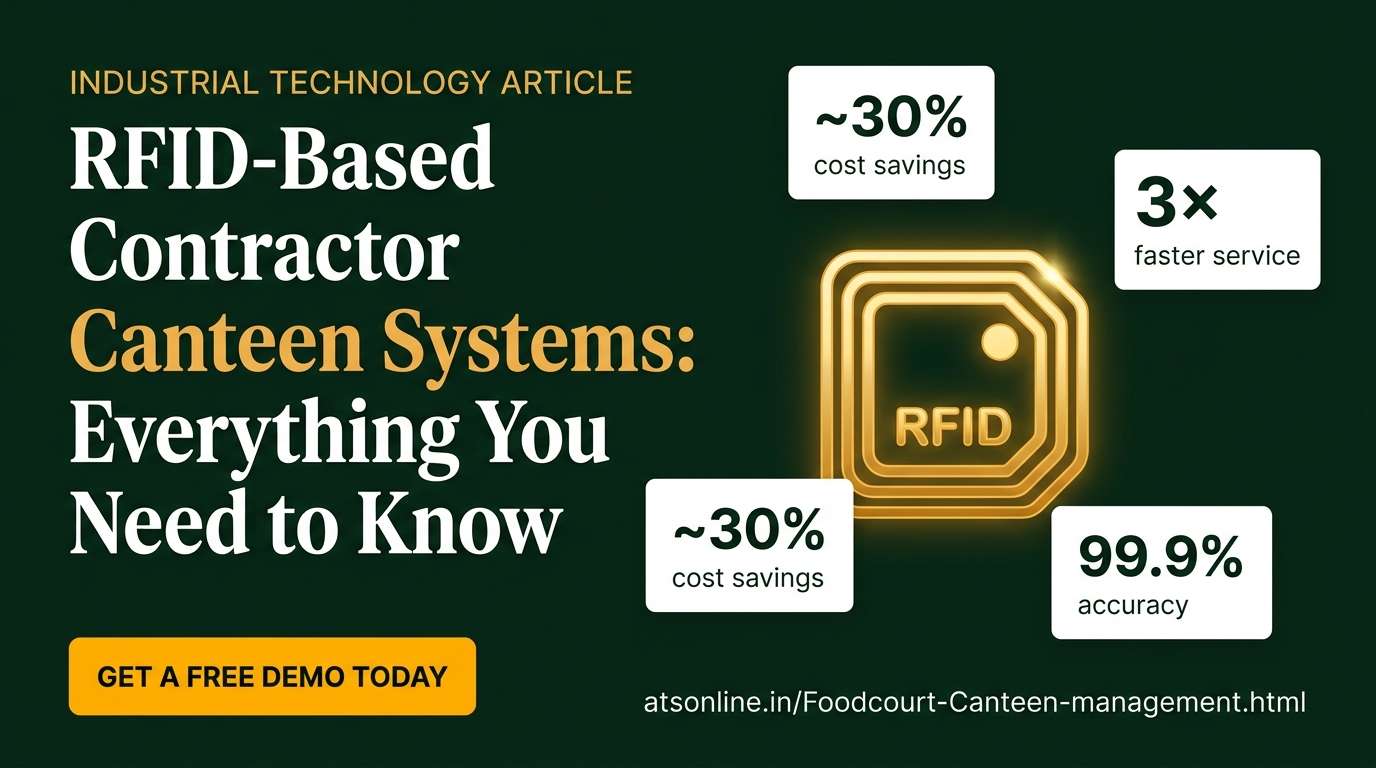
| ~30% Average reduction in food cost leakage | 3× Faster meal service vs paper tokens | 99.9% Transaction accuracy with RFID | 6 mo Typical ROI payback period |
What Is an RFID-Based Contractor Canteen System?
An RFID-based contractor canteen system is a technology-driven meal management solution that uses Radio Frequency Identification (RFID) cards or wristbands to authenticate, track, and record every meal transaction made by a contractor employee at a workplace canteen or food court.
Each contractor is issued a unique RFID tag — typically a proximity card or wristband — that stores their identity, contractor organisation, shift timing, meal entitlement quota, and subsidy level. At the canteen counter, a fixed or handheld RFID reader instantly scans the card and either approves or declines the meal request based on pre-programmed rules.
Unlike barcode-based systems that require line-of-sight, RFID readers can scan cards through pockets and pouches at distances of up to 10 cm — making service faster and more hygienic in high-footfall industrial canteens.
Why Traditional Contractor Canteen Management Fails
Before exploring RFID solutions, it is worth understanding the pain points that plague conventional approaches:
- Paper token abuse: Tokens are easily duplicated, shared, or presented by unauthorised individuals.
- Manual registers: Prone to human error, difficult to audit, and impossible to reconcile in real time.
- Long queues: Manual verification slows meal service significantly during peak shift changeovers.
- No real-time visibility: Management has no live data on how many meals have been served per contractor company or per shift.
- Subsidy disputes: Without precise records, billing disputes between the organisation and contractor companies are frequent and time-consuming.
- Wastage and over-ordering: Without accurate headcount data, catering teams cannot plan quantities, leading to over-production or shortages.
How RFID Contractor Canteen Systems Work — Step by Step
1. Enrolment and Card Issuance
Every contractor employee is enrolled into the central canteen management software. Their RFID card is linked to their profile — including contractor company name, project site, shift code, meal type entitlements (breakfast, lunch, dinner, tea), and daily meal limits. The entire enrolment process typically takes under two minutes per employee.
2. Meal Redemption at the Counter
The contractor taps or waves their RFID card at the reader terminal installed at the canteen entry or serving counter. The system checks in real time: Is this a valid card? Is the employee scheduled for this shift? Has the daily meal quota been reached? If all parameters are satisfied, the system approves and logs the transaction instantly.
3. Real-Time Data Capture
Every approved and rejected transaction is captured in the cloud-based or on-premise database with a timestamp, employee ID, meal type, counter number, and shift code. This generates a live dashboard view accessible to HR managers, catering supervisors, and finance teams simultaneously.
4. Automated Billing and Reconciliation
At the end of each day, week, or billing cycle, the system automatically generates contractor-wise and department-wise meal consumption reports. These are used for internal cost allocation and for generating accurate invoices for contractor companies availing subsidised meals.
5. Integration with HR and ERP Systems
Modern RFID canteen platforms integrate seamlessly with existing HRMS, ERP, and payroll software. This enables meal deductions to be reflected automatically in salary processing without any manual data entry, eliminating an entire layer of administrative effort.
Key Features to Look for in an RFID Contractor Canteen System
| Feature | Why It Matters for Contractors |
|---|---|
| Multi-Shift Support | Handles unlimited shift configurations with different meal entitlements per shift — essential for rotating or irregular contractor schedules. |
| Offline Mode | Terminals operate offline and sync transactions once connectivity is restored — critical for industrial sites with unreliable internet. |
| Contractor Company Segregation | Segregates meal data by contractor company for accurate cross-billing and subsidy management. |
| Meal Limit Controls | Configure daily, weekly, or per-meal-type limits per employee or batch to prevent over-consumption and unauthorised top-ups. |
| Real-Time Reporting Dashboard | Live consumption data helps catering teams adjust food production mid-shift, reducing wastage significantly. |
| Mobile & Web Access | HR and facility managers can access reports from any device without being tied to a desktop terminal. |
| Guest Meal Management | Issue temporary access for visitors or day-labour contractors without creating permanent records. |
| ERP & Payroll Integration | Direct API or file-based integration with SAP, Oracle, or custom HRMS eliminates duplicate data entry and reduces errors. |
Top Benefits of RFID Canteen Systems for Contractor Management
Eliminate Meal Fraud and Buddy Feeding
In a busy industrial canteen serving hundreds of contractors, it is virtually impossible for staff to visually verify every person’s identity. RFID systems eliminate this weakness entirely. Each card is uniquely coded and the system enforces daily limits — so even if a card is loaned to another person, the quota is exhausted quickly and the system flags anomalies automatically.
Accurate Cross-Billing Between Departments and Contractors
One of the most significant operational headaches for HR and finance teams is accurately charging each contractor company for meals consumed by their workers. RFID systems generate contractor-wise consumption reports with complete audit trails, making cross-billing disputes a thing of the past and accelerating invoice cycles.
Faster Queue Management
RFID authentication takes less than 0.5 seconds per employee. Compared to a manual verification process that might take 15–30 seconds per person, this means a canteen serving 500 contractors per meal shift can clear queues three to four times faster — a genuine operational advantage in shift-change windows that are only 30–45 minutes long.
Live Headcount and Wastage Reduction
Live dashboards showing real-time meal redemption allow kitchen supervisors to adjust production mid-shift. If only 60% of expected contractors have arrived for a particular shift, the kitchen can scale back preparation accordingly — directly reducing food wastage, a major cost driver in large canteens.
Compliance and Audit Readiness
Organisations subject to labour compliance audits, ISO certifications, or government inspections need watertight documentation of contractor welfare facilities. RFID canteen systems provide time-stamped, tamper-proof transaction logs that satisfy any audit requirement without the need for manual record compilation.
Industries That Benefit Most from RFID Contractor Canteen Systems
While the technology is applicable across sectors, the following industries derive the most significant operational benefits:
- Manufacturing and automotive plants — high contractor headcount with multiple shifts and strict subsidy control requirements
- Construction and infrastructure projects — large temporary workforces with daily headcount fluctuations
- Oil, gas, and petrochemical facilities — stringent access and identity control requirements alongside catering management
- IT parks and SEZs — multiple contractor companies sharing a common food court with individual billing needs
- Hospitals and healthcare campuses — contract nursing and support staff requiring different meal entitlements from permanent employees
- Power plants and utilities — remote locations requiring offline-capable systems with periodic data sync
RFID vs Other Canteen Technologies: A Quick Comparison
| Technology | Speed | Fraud Resistance | Offline Capability | Cost |
|---|---|---|---|---|
| Paper Tokens | Slow | Low | Yes | Very Low |
| Barcode Cards | Medium | Medium | Partial | Low |
| RFID Cards ✓ | Fast | High | Yes | Medium |
| Biometric | Medium | Very High | Partial | High |
| Mobile QR | Fast | Medium | No | Low |
RFID cards represent the optimal balance of speed, security, offline capability, and cost — making them the technology of choice for high-footfall contractor canteen environments.
Implementation Roadmap: Getting Started with RFID Canteen Management
- Assess your current canteen operations — meal volumes, number of contractor companies, shift structures, and existing IT infrastructure.
- Define meal entitlement policies — which contractors get which meals, at what subsidy level, and with what daily limits.
- Select a vendor with industrial experience — look for proven deployments in your industry segment and references from similar-scale operations.
- Plan hardware placement — determine the number and placement of RFID reader terminals based on peak footfall and canteen layout.
- Enrol your contractor workforce — coordinate with contractor companies to complete bulk enrolment before go-live.
- Train catering and HR staff — most modern systems require minimal technical knowledge to operate day-to-day.
- Run a parallel period — operate the RFID system alongside your existing method for two to four weeks before full cutover.
- Review and optimise — use the first three months of reports to fine-tune entitlement rules, identify anomalies, and optimise kitchen production planning.
Pro Tip: Insist on a vendor that provides a dedicated implementation manager and post-go-live support for at least 90 days. The quality of onboarding support is often the single biggest factor determining project success.
What Does an RFID Contractor Canteen System Cost in India?
Pricing varies based on the number of employees, number of canteen terminals, software features required, and whether you prefer a perpetual licence or a SaaS subscription model. For a mid-size facility with 500–1,000 contractor employees, a fully implemented RFID canteen management system typically ranges between ₹1 lakhs and ₹2 lakhs for the initial setup, with annual maintenance costs of 15–20% of the licence value.
When evaluating cost, factor in the savings generated: a system that eliminates even 10% food leakage in a canteen spending ₹15 lakhs per month generates ₹18 lakhs in annual savings — a payback period of well under 12 months in most cases.
Frequently Asked Questions
How does RFID prevent fraud in contractor canteens?
Each RFID card is uniquely coded to one contractor employee. The system enforces daily meal limits and shift-based access rules, so even if cards are shared, the quota is quickly exhausted and anomalies are flagged automatically in the reporting dashboard.
Can the system manage multiple contractor companies together?
Yes. RFID canteen software segregates meal data by contractor company, enabling separate entitlement rules, subsidy levels, and automated billing reports for each company — all managed from a single platform without manual separation.
Does the RFID canteen system work without internet connectivity?
Most industrial RFID canteen systems include an offline mode where terminals store transactions locally and sync automatically to the central server once connectivity is restored. This makes them ideal for remote or semi-urban manufacturing sites.
How long does it take to implement an RFID canteen system?
A typical implementation for 500–1,000 contractor employees takes 4–8 weeks from contract signing, including hardware installation, software setup, data migration, and staff training — with minimal disruption to canteen operations.
Can RFID canteen data integrate with our HR or ERP system?
Yes. Leading RFID canteen platforms offer API-based and file-based integration with SAP, Oracle, and custom HRMS systems, allowing automatic meal deductions in payroll and real-time cost allocation across departments and contractor accounts.
What is the ROI on an RFID contractor canteen system in India?
Most organisations recover their investment within 6–12 months through reduced food leakage, lower administrative costs, and elimination of billing disputes. Savings of 20–30% on total canteen expenditure are commonly reported post-deployment.
Ready to Transform Your Contractor Canteen Operations?
ATS has helped hundreds of manufacturing plants, IT parks, and industrial campuses across India implement RFID-based canteen management systems that deliver measurable results from day one. Talk to our team today for a free consultation and live demo.
🔗 Explore Our Canteen Management Solutions
📞 Call / WhatsApp: +91 98100 78010 |