
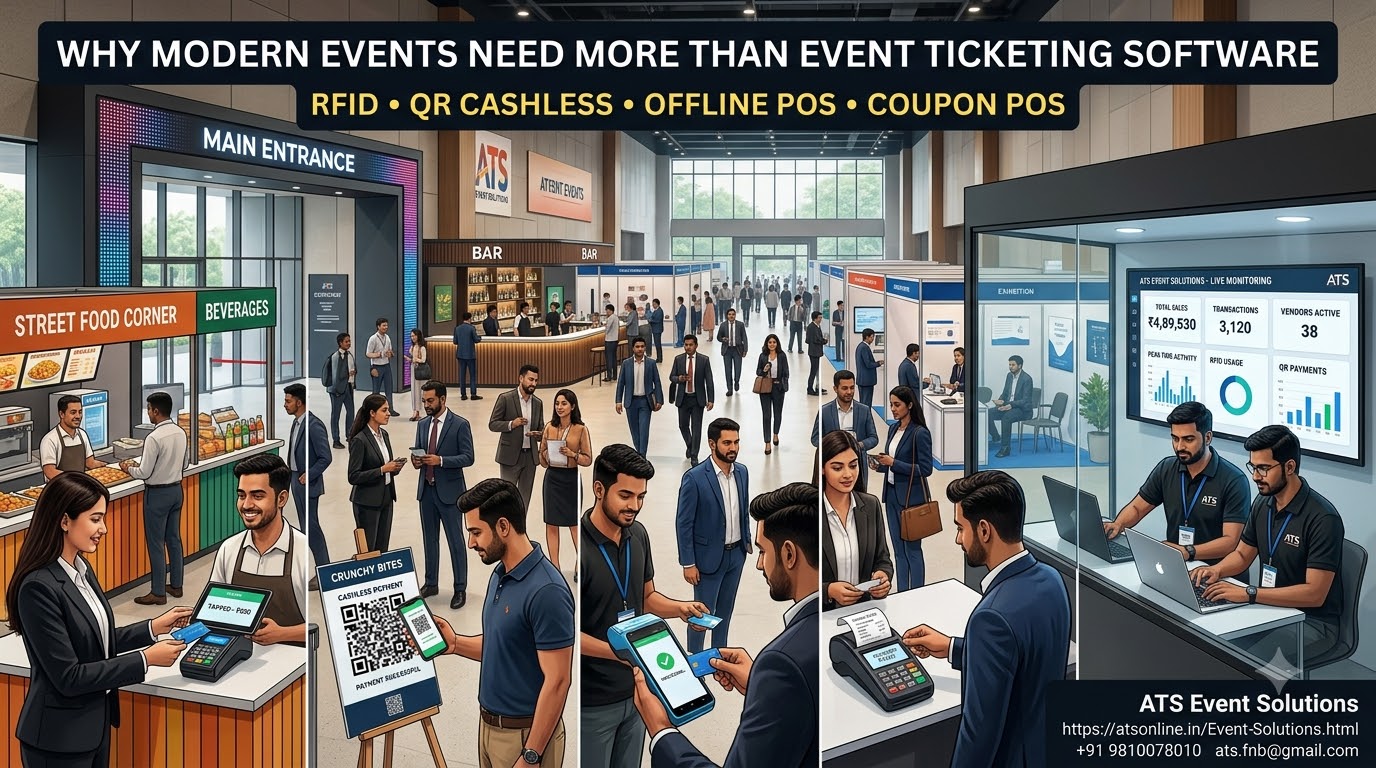
Event Payment Solutions: The Complete Guide to Cashless Payments, RFID Cards and POS Billing for Events
Compare event payment solutions including QR cashless wallets, RFID prepaid cards, offline Android POS and thermal coupon printing for festivals, concerts and exhibitions.
Organizing a successful event requires more than arranging a venue, booking performers and attracting visitors. Behind every food festival, exhibition, concert, corporate gathering or college fest is a complex payment operation involving entry counters, food stalls, beverage vendors, cashiers and financial settlements.
When thousands of visitors arrive within a limited period, traditional payment methods can create long queues, cash-handling problems, coupon discrepancies and delays in settling payments with vendors.
This is why professional event payment solutions have become an important part of modern event operations.
From QR-based cashless payments and RFID prepaid cards to offline Android POS billing and thermal coupon printing, event organizers now have several ways to streamline transactions and improve financial visibility.
The challenge is choosing the right solution for the event’s size, venue, internet connectivity, vendor structure and customer payment preferences.
In this guide, we explore the main types of event payment systems, their benefits, how to select the right technology and how Advance Technology Systems (ATS) helps organizers manage event billing more efficiently.
What Are Event Payment Solutions?
Event payment solutions are software and payment-management systems designed to handle transactions at temporary or permanent event venues.
They help organizers collect payments, process purchases, issue coupons or prepaid credentials, track vendor sales and reconcile financial records after an event.
Depending on the system, an event payment solution may include:
- QR-based cashless wallets for attendees.
- RFID prepaid cards for purchases at participating counters.
- Android POS software for billing at individual stalls.
- Thermal coupon printing for food, beverages and other purchases.
- Gate entry and ticket validation software.
- Recharge counters and prepaid balance management.
- Sales reports and vendor settlement records.
The purpose is to make payments faster, create more reliable transaction records and simplify the work involved in managing multiple counters and vendors.
Not every event requires every feature. A small food festival may need only a few billing terminals, while a multi-day exhibition may benefit from a combination of RFID cards, offline POS terminals and centralized reporting.
Why Do Event Organizers Need a Dedicated Payment System?
Events have operational requirements that differ from those of a permanent retail shop.
Customer traffic can rise dramatically during peak hours. Vendors may operate independently, temporary staff may have limited training, and organizers often need to close accounts immediately after the event.
A dedicated event payment system helps address several common challenges.
1. Long queues at food and beverage counters
Visitors have limited patience when waiting for refreshments at concerts, exhibitions and festivals.
Cash counting, making change and manually preparing coupons can slow transactions. A suitable QR, RFID or POS-based system can simplify the payment process and help counters serve customers more efficiently.
2. Revenue discrepancies
When multiple vendors collect cash independently, organizers may find it difficult to compare reported sales with actual collections.
Digital transaction records and standardized billing procedures make it easier to investigate discrepancies and prepare settlement reports.
3. Manual coupon handling
Pre-printed coupon booklets can create problems involving unused inventory, missing coupons, duplicate redemption and manual counting.
On-demand thermal coupon printing offers an alternative in which coupons are printed when sold. Systems with unique QR codes can also verify redemption and help prevent the same coupon from being used twice.
4. Unreliable internet connectivity
Temporary venues may have weak W-fi, unstable mobile data or limited network infrastructure.
An offline-capable POS system can continue processing supported transactions locally. A cloud-based cashless wallet, by contrast, needs reliable connectivity for its online transaction and synchronization workflow.
The correct choice depends on the venue’s connectivity and the consequences of a service interruption.
5. Complicated vendor settlements
At a multi-vendor event, the organizer may need to calculate sales for every stall, account for refunds and discounts, and determine the amounts payable to individual vendors.
A well-configured payment system provides transaction records that help simplify these calculations and reduce dependence on manual spreadsheets.
Four Types of Event Payment Solutions
There is no single payment technology that is ideal for every event. The following four approaches cover different operating requirements.
1. QR-Based Cashless Payment System
A QR-based cashless system allows attendees to use a unique QR code linked to a digital wallet or account.
A typical workflow involves issuing a QR credential to the attendee, adding money to the wallet and scanning the code when making purchases at participating stalls.
The transaction is processed by the system and recorded against the associated account.
Key advantages
- Attendees can use a QR code displayed on a smartphone or printed credential, depending on the implementation.
- Vendors can use compatible smartphones or tablets instead of dedicated RFID readers.
- Cloud-based systems can provide centralized transaction records and live sales monitoring.
- Digital transaction logs can help simplify vendor reconciliation.
- The workflow can reduce dependence on physical coupons.
Important considerations
A cloud-based QR payment system depends on internet connectivity. Organizers should test network coverage at all payment points, provide a fallback procedure and confirm how refunds, duplicate scans and failed transactions are handled.
QR payments are particularly worth considering for exhibitions, carnivals, nightclubs and events where organizers want centralized sales visibility without deploying specialised RFID readers at every counter.
2. RFID Prepaid Card System
An RFID cashless system uses compatible prepaid cards or wristbands to identify an attendee’s account and process purchases at participating counters.
Visitors load funds at designated recharge points and tap their cards on compatible readers when buying food, beverages or other items.
The system records the transaction and updates the available balance according to its configuration.
Key advantages
- Fast contactless transactions.
- Reusable cards for suitable recurring events.
- Centralized transaction records.
- Sales reporting by participating counter.
- Reduced reliance on paper coupon booklets.
- Support for offline-first deployments, depending on the system architecture.
RFID can be especially useful for multi-day festivals, campus events, permanent food courts and venues with repeat visitors.
However, RFID systems require compatible cards and readers. Organizers should also understand how lost cards, refunds, recharge updates and synchronization between terminals are handled.
3. Android Offline POS Billing
Android POS software allows vendors to process bills using compatible Android smartphones or tablets.
Depending on the software, a Bluetooth thermal printer can be connected to print receipts. Transactions can be stored locally and synchronized later if the system supports offline processing and subsequent synchronization.
Key advantages
- Portable billing terminals.
- Relatively simple deployment for temporary stalls.
- Reduced dependence on continuous internet connectivity for supported transactions.
- Receipt printing where required.
- Digital sales records.
- Suitability for pop-up stalls, caterers, food trucks and temporary food courts.
Android POS is useful when individual vendors need to bill their own customers without a complex centralized cashless wallet.
Before selecting a system, verify whether it supports the required payment methods, offline transaction limits, receipt formats and reporting workflow.
4. Thermal Coupon Printing POS
A coupon POS system prints value-based or otherwise configured coupons at a designated counter.
Visitors purchase coupons and redeem them at participating stalls. The organizer or vendor collects the coupons according to the event’s settlement rules.
Modern on-demand printing solutions can generate coupons with unique serial numbers, timestamps or QR codes. Where redemption verification is supported, the system can mark a coupon as used and reject duplicate redemption attempts.
Key advantages
- Coupons are printed when needed instead of being produced in large quantities in advance.
- Organizers can configure supported coupon denominations.
- Thermal printers can produce coupons quickly.
- Digital printing records can help reconcile collections.
- Unique coupon identifiers can support redemption controls.
- Vendors can settle sales according to collected coupons and system reports.
Coupon POS is particularly suitable for one-day events, food festivals, college fests, bars, concerts and venues where customers purchase coupons centrally before visiting vendors.
Event Payment Solutions Compared
Use this table to shortlist the appropriate technology for your event.
| Requirement | QR Cashless Wallet | RFID Prepaid Cards | Android Offline POS | Coupon POS |
|---|---|---|---|---|
| Primary payment method | QR-linked wallet | RFID card or wristband | Configured POS payment workflow | Printed coupons |
| Internet dependency | Required for cloud operations | Depends on architecture | Offline billing may be supported | Depends on implementation |
| Dedicated RFID readers | No | Yes | No | No |
| Thermal printer | Not necessarily | Not necessarily | Optional or configuration-dependent | Generally required |
| Live centralised monitoring | Yes, when connected | Depends on configuration | May require synchronisation | Depends on implementation |
| Best suited for | QR-based cashless events | Multi-day and repeat-attendance events | Temporary vendor counters | Coupon-based event payments |
| Key consideration | Network reliability | Card and reader deployment | Device compatibility and offline support | Printing and redemption controls |
The best choice depends on the event’s payment model, customer experience requirements and technical infrastructure.
How to Choose the Right Payment System for Your Event
Small food festival or community event
For a small event with a limited number of vendors, Android POS billing or thermal coupon printing may be sufficient.
Android POS is appropriate when vendors need to bill their own customers. Coupon printing may be preferable when the organizer wants to collect money centrally and distribute value-based coupons for redemption at stalls.
College fest or cultural festival
College festivals often have several food stalls, games, merchandise counters and entry points.
A combination of coupon printing, gate ticketing and POS billing can help organise payments across these areas. For larger festivals, RFID cards may be useful where attendees make repeated purchases over several days.
Multi-day music festival
A multi-day event may benefit from reusable RFID cards or wristbands, particularly where attendees want a consistent cashless experience across multiple vendors.
The organizer should plan card distribution, recharge stations, lost-card handling, refund procedures and terminal connectivity well before opening day.
Exhibition or trade show
Exhibitions may contain food counters, merchandise vendors, paid activities and registration desks.
A QR-based cashless system can provide centralized monitoring, while dedicated POS or coupon counters can support vendors with different operating requirements.
Nightclub or concert venue
For venues with intense peak-hour demand, organizers should prioritise fast counter transactions, clear audit records and quick closing procedures.
Depending on the venue, QR wallets, RFID cards or thermal coupon POS can support these needs. Gate entry software may also be required for access validation and entry reporting.
How Event Payment Systems Help Prevent Revenue Leakage
Revenue discrepancies can occur when transactions are missed, coupons are reused, refunds are not properly documented or vendor settlements rely entirely on manual calculations.
No software can guarantee the complete elimination of fraud, but suitable controls can reduce opportunities for error and make exceptions easier to investigate.
Standardize transaction recording
Require participating vendors to use the agreed billing or payment process. Document how discounts, complimentary items, cancellations and refunds are authorized.
Use unique coupon identifiers
Where coupon printing and redemption software supports unique serial numbers or QR codes, use them to verify coupon validity and prevent duplicate redemption.
Maintain transaction records
Review available records by vendor, counter, date and transaction type. Investigate unexplained differences between system reports and physical collections.
Establish clear vendor settlement rules
Before the event, document commission arrangements, applicable taxes, refunds and payment timelines.
At closing, compare system records with the agreed settlement method and retain supporting reports.
Reconcile prepaid balances
For RFID and QR-based wallets, establish procedures for recharges, deductions, unused balances and refunds. Verify how transactions are synchronized when terminals operate offline.
Good financial control combines software, staff training, documented procedures and appropriate supervision.
Why Offline Billing Matters at Temporary Events
Temporary events often operate in locations where network connectivity is less predictable than it is in a permanent business premises.
A network interruption can affect online billing, remote monitoring and payment verification. An offline-capable POS system reduces this dependency for transactions that it is designed to process locally.
For example, a food stall using compatible Android POS software may continue entering bills and printing receipts without a continuous internet connection. If the system supports later synchronization, stored transactions can be uploaded when connectivity returns.
This is different from a cloud-native wallet, which generally needs a working network for online account balances and transaction updates.
Organizers should therefore answer three questions before selecting a system:
- Which operations must continue if internet connectivity fails?
- How will the system avoid inconsistent balances or duplicate transactions?
- How will all records be reconciled after connectivity is restored?
These questions are more useful than simply asking whether a product is described as online or offline.
Planning Vendor Settlements and Event Reconciliation
A well-planned event payment system should help organizers close their accounts without relying on hours of manual counting.
Consider a food festival with ten vendors. Each vendor records sales using the designated payment system or coupon process.
At the end of the event, the organizer needs to establish:
- Total sales recorded for each vendor.
- Total cash or other collections received through the designated payment process.
- Coupon quantities issued and redeemed, where applicable.
- Refunds, voids and adjustments.
- Vendor commissions or agreed deductions.
- Amount payable to each vendor.
- Any unexplained differences requiring investigation.
Digital reports can provide a structured starting point for these calculations. For coupon-based systems, physical coupon counts may also form part of the reconciliation process.
The organizer should confirm whether the chosen software calculates vendor settlements automatically or simply supplies the reports required to calculate them.
Tax reporting also depends on the underlying transaction structure and applicable rules. Software reports should be reviewed alongside the event’s accounting requirements.
Advance Technology Systems (ATS)
Website: https://atsonline.in/Event-Solutions.html
Phone: +91 9810078010
Email: ats.fnb@gmail.com
Why Consider ATS Event Payment Solutions?
Advance Technology Systems (ATS) provides event-oriented billing and payment solutions for organizers who need to manage different types of transactions across temporary or permanent venues.
Rather than requiring every event to use a single payment method, ATS offers several approaches that can be selected according to operational requirements.
WalletQrPay: Cloud-Based QR Cashless Payments
ATS’s WalletQrPay system is designed around QR-linked customer wallets and cloud-based transaction management.
The published workflow includes issuing a QR credential, adding money, scanning the code for purchases and processing unused-balance refunds through the configured process.
It is worth considering for organizers who want centralized transaction visibility and a payment experience based on QR codes rather than dedicated RFID readers.
Because it is cloud-based, organizers should plan for dependable internet connectivity and confirm the exact refund and payment workflows before the event.
ATS RFID Cashless Event System
The RFID solution supports prepaid cards, compatible readers and recharge points.
It is designed for venues that need repeated card-based transactions, including multi-day festivals, exhibitions, food courts and similar environments.
Its suitability depends on the number of counters, card deployment requirements and the desired offline or synchronization arrangement.
ATS Android Offline POS
ATS also offers Android POS billing for portable vendor counters.
The published product information describes Android-device billing, Bluetooth thermal receipt printing and offline transaction processing with later synchronization where supported.
This approach can suit caterers, temporary food stalls and other event vendors who need a relatively portable billing setup.
ATS Coupon POS and Event Coupon Printing
ATS coupon solutions support thermal coupon printing for entry counters and participating vendor stalls.
Depending on the selected product, organizers can use printed serial numbers, QR-based verification and transaction reports to support coupon control and settlement.
This approach can be useful for one-day events, food festivals, college fests and other venues that prefer coupon-based transactions.
Combining multiple systems
Some events need different payment workflows for different areas.
For example, an organizer might use gate ticketing for entry, RFID cards for prepaid purchases, Android POS at selected independent vendor stalls and coupon printing for a designated food area.
A mixed deployment can be effective, but the organizer must define how transactions from each system will be reconciled. Do not assume that all products share one database or automatically produce a unified report; confirm the available integration and reporting capabilities with ATS.
Explore the ATS Event Solutions page to compare the available approaches.
Event Payment System Implementation Checklist
Before finalizing a solution, work through this checklist.
- Estimate attendee numbers and expected transactions per hour.
- Count the entry gates, recharge points and vendor counters.
- Decide whether customers will use QR wallets, RFID cards, direct POS billing or coupons.
- Check internet and local network coverage at every operating area.
- Confirm compatible phones, tablets, RFID readers and thermal printers.
- Define procedures for failed payments, refunds and lost cards.
- Decide how vendors will be paid and what deductions apply.
- Confirm the reports available for sales and reconciliation.
- Train cashiers, gate staff and vendor supervisors.
- Test the complete workflow before the event opens.
- Establish backup procedures for power, connectivity or hardware failures.
- Confirm technical support availability during the event.
Completing these checks in advance reduces the risk of operational surprises when visitor traffic peaks.
Advance Technology Systems (ATS)
Website: https://atsonline.in/Event-Solutions.html
Phone: +91 9810078010
Email: ats.fnb@gmail.com
Frequently Asked Questions About Event Payment Solutions
1. What is the best payment solution for an event?
The best solution depends on event size, transaction volume, connectivity, vendor structure and the customer experience you want to provide. QR wallets, RFID prepaid cards, offline POS billing and thermal coupons each serve different requirements.
2. Can an event operate without cash?
Yes, an event can use a cashless model if the chosen payment methods and infrastructure support it. Organizers should still define a fallback procedure for failed transactions and decide whether any cash collection or recharge facility will remain available.
3. What is the difference between QR cashless payments and RFID cards?
QR payments use a scannable code linked to an account or wallet, while RFID payments use a compatible physical card or wristband. QR systems can reduce the need for dedicated RFID readers, whereas RFID systems offer a tap-based experience and may support offline-first configurations.
4. Can event POS software work without the internet?
Some POS systems support local offline billing. Cloud-based wallets and remote transaction monitoring generally require connectivity. Always confirm the specific product’s offline behavior and recovery process.
5. How can organizers manage multiple vendors?
Use a consistent transaction-recording process and maintain sales records by vendor or counter. Depending on the system, reports can help calculate vendor settlements, commissions and outstanding amounts.
6. How can event organizers prevent coupon fraud?
Use controlled coupon issuance, unique serial numbers or QR codes where supported, documented redemption procedures and end-of-event reconciliation. These measures reduce the risk of duplicate redemption and unexplained coupon discrepancies.
7. Is RFID suitable for a one-day event?
It can be, but the setup effort and hardware costs should be justified by the event’s scale and payment requirements. For some small one-day events, Android POS or thermal coupon printing may be simpler.
8. Can organizers combine QR, RFID and coupon systems?
Yes, a hybrid deployment is possible when each system is suitable for its assigned workflow. Confirm how transaction data, refunds and vendor settlement reports will be brought together.
9. What hardware is required for event payment software?
Requirements vary. QR-based systems may work with compatible smartphones or tablets, RFID systems require suitable readers and cards, Android POS may use a Bluetooth thermal printer, and coupon POS typically requires a compatible terminal and printer.
10. How quickly can an event payment system be deployed?
Deployment time depends on the selected technology, number of counters, card preparation, hardware configuration, connectivity and staff training. Test the complete process before committing to a launch schedule.
11. How does event payment software help with accounting?
Transaction records and sales reports help organizers compare collections, review vendor sales and calculate settlements. Final accounting and tax treatment should follow the event’s actual business arrangements and applicable requirements.
12. Where can I find event payment solutions in India?
Advance Technology Systems offers several event payment approaches, including QR cashless payments, RFID prepaid cards, Android POS billing and coupon POS. Visit the ATS Event Solutions page to review the available options.
Conclusion: Choose an Event Payment System That Fits Your Operations
Efficient payment management is an important part of delivering a successful event.
Long queues, manual coupon counting, inconsistent vendor records and unreliable connectivity can create unnecessary pressure for organizers and staff. The right event payment solution can help streamline transactions, improve financial visibility and make end-of-event reconciliation more manageable.
QR wallets are worth considering when cloud-based central monitoring is a priority. RFID cards can suit repeated prepaid transactions across multiple counters. Android offline POS is useful for portable vendor billing, while thermal coupon printing can simplify controlled coupon-based sales.
The best solution is the one that fits the event’s real operating requirements, not simply the one with the most features.
Planning a festival, exhibition, concert, college fest or corporate event?
Explore the ATS Event Payment Solutions page to compare QR cashless payments, RFID cards, Android POS and coupon printing.
Contact Advance Technology Systems to discuss your event size, vendor count, connectivity requirements and settlement workflow.
Advance Technology Systems (ATS)
Website: https://atsonline.in/Event-Solutions.html
Phone: +91 9810078010
Email: ats.fnb@gmail.com


