
Walking into a busy modern multi-specialty healthcare facility often feels overwhelming, primarily because an inefficient Hospital Queue Management System causes chaotic waiting areas and stressed-out patients. Furthermore, traditional paper-clip ticketing methods and disorganized physical lines lead to frustration, missed appointments, and severe bottlenecks across critical zones like outpatient departments, diagnostics, and dispensaries. Therefore, implementing a structured ATS Token Display System has become essential for enterprise healthcare providers aiming to optimize operations, reduce perceived wait times, and elevate overall clinical service delivery.
Healthcare administrators continually look for innovative ways to streamline the patient journey from registration to discharge. In addition, modern clinics must manage complex internal routing where patients move rapidly between consultation chambers, pathology labs, and pharmacy counters. Consequently, adopting advanced patient flow management software transforms unpredictable waiting rooms into orderly, calm environments. This comprehensive guide explores how cutting-edge hardware and software ecosystems revolutionize healthcare delivery across every single department.
The Anatomy of Patient Flow: From OPD to Labs and Pharmacy
Managing patient flow inside a busy hospital requires precise orchestration across multiple touch points, each presenting unique operational hurdles. When a patient arrives at an outpatient department (OPD), their journey begins with registration, followed by vital signs screening, doctor consultation, diagnostic testing, and finally, medication pickup. Moreover, if any single node in this chain experiences a backup, the entire facility suffers from cascading delays. For example, a stalled doctor’s queue instantly creates overcrowding in the pharmacy and laboratory waiting bays.
To prevent these operational logjams, modern facilities rely on a comprehensive multi-department queue management system that tracks visitors at every step. Consequently, patients receive a unified digital token upon entry that remains active throughout their entire hospital visit. Furthermore, administrative teams utilize this data to identify where patients spend the most time, allowing for better staff allocation. Ultimately, synchronizing these disparate touch points ensures that clinical staff maintain high productivity while patients experience clear, transparent routing.
How ATS Wireless Token Display Systems Transform Hospital Operations
Upgrading legacy infrastructure requires reliable, scalable hardware that integrates smoothly into existing architectural layouts without invasive wiring. The ATS Token Display System provides robust wireless token display for hospitals, utilizing reliable radio-frequency or Wi-Fi communication protocols. In addition, these vibrant LED and LCD screens mount easily on walls or ceilings, broadcasting current token numbers alongside customized audio voice chimes that capture patient attention instantly.
Deploying a sophisticated wireless queue system eliminates expensive renovation costs associated with running ethernet cables through concrete walls. Moreover, engineering teams can configure these display boards to show multi-language announcements, promotional healthcare tips, or real-time token sequencing for multiple doctors simultaneously. Consequently, patients sit comfortably in designated waiting zones rather than crowding tightly around examination room doors, dramatically reducing noise pollution and infection transmission risks in clinical corridors.
Key Insight: Implementing wireless visual displays and audio announcements reduces perceived patient wait times by up to thirty-five percent while virtually eliminating missed callouts and corridor congestion.
Coordinating Doctor Consultations with Wireless Desk Keypads
Empowering medical practitioners with intuitive control tools remains paramount for maintaining seamless consultation flow inside busy OPD chambers. When a physician finishes examining a patient, they simply press a dedicated physical or virtual button on a wireless desk keypad to recall the next sequence number. Furthermore, this immediate action triggers both the main corridor display and localized department monitors to update instantly, ensuring total transparency.
Here are the primary advantages of integrating specialized doctor desk keypads within clinical consultation rooms:
- Instant Recall: Physicians can recall, skip, or hold tokens with a single keystroke, minimizing administrative distractions.
- Status Management: Doctors can toggle their status to “Busy,” “Break,” or “Available,” which automatically updates waiting room displays.
- Seamless Transfers: Practitioners can instantly route a patient directly to specialized labs or injection rooms without issuing new physical tickets.
- Zero Software Clutter: Compact hardware keypads operate independently of heavy desktop applications, ensuring uninterrupted up-time.
By giving physicians direct control over their incoming queues, hospitals prevent appointment scheduling anomalies and reduce idle time between consultations. In addition, nurses and medical assistants can monitor real-time room pacing, stepping in to prep the next patient while the doctor finishes documentation.
Integrating Diagnostic Labs and Pharmacy Counters into the Queue
Once a doctor consultation concludes, patients frequently require blood tests, imaging diagnostics, and prescribed medications from the hospital dispensary. However, fragmented systems often require patients to pull entirely new, unlinked tickets at every single counter, causing widespread confusion. Therefore, an effective Hospital Queue Management System connects OPD records directly with lab queue management systems and pharmacy token display setups.
When a doctor orders a blood panel, the laboratory counter automatically receives the patient’s token credentials in its queue queue, prioritizing them based on urgency or arrival time. Similarly, the pharmacy counter prepares prescriptions in advance as soon as the doctor signs off digitally, drastically shrinking wait times at the dispensary window. Consequently, this seamless cross-departmental integration eliminates repetitive data entry, reduces human error, and ensures that vulnerable patients spend minimal time standing in lines.
Eliminating Corridor Crowding and Enhancing Patient Experience
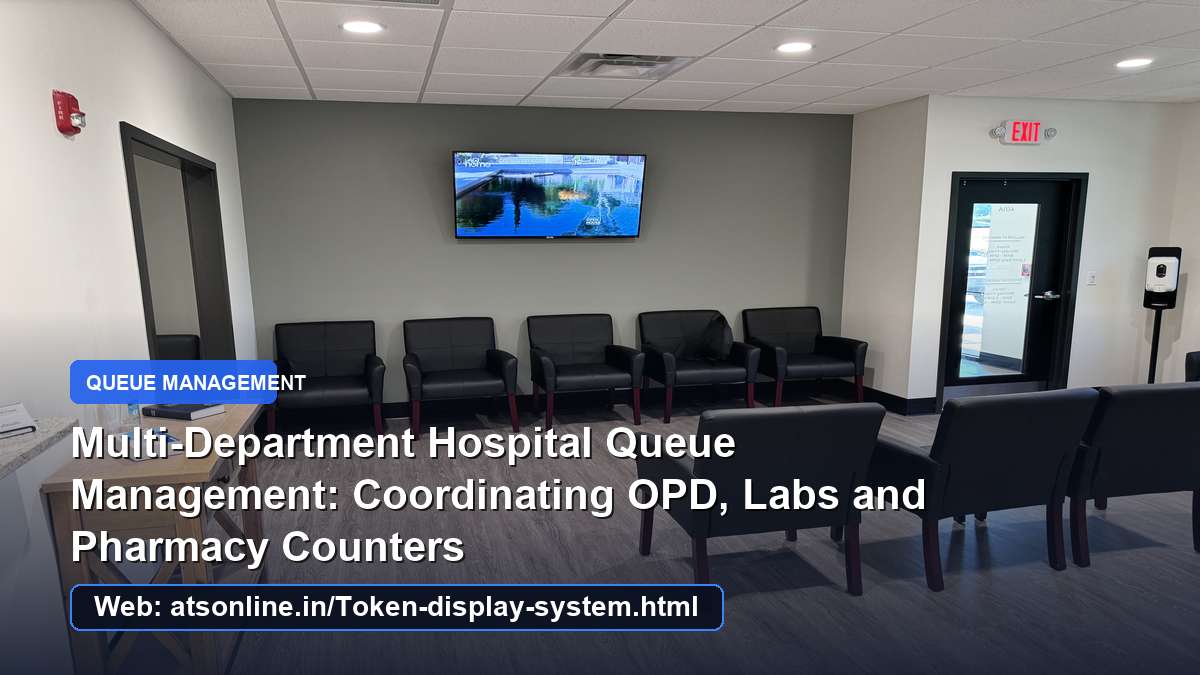
Crowded hospital corridors create an atmosphere of anxiety, elevate stress levels for recovering patients, and severely compromise facility hygiene standards. Traditional queuing forces individuals to huddle anxiously outside doctor doors, often blocking walkways and creating a chaotic environment for medical staff pushing gurneys. Fortunately, deploying a centralized opd token display system allows patients to relax in designated seating zones equipped with television screens and digital signage.
Furthermore, advanced healthcare queue management solutions support SMS notifications and mobile web applications, enabling patients to track their queue status remotely. For example, a patient can grab a digital token, sit in the hospital cafeteria or their car, and monitor their live position on their smartphone. As a result, facility noise levels drop significantly, ambulatory pathways remain clear, and overall patient satisfaction scores increase exponentially.
Real-Time Administrative Analytics for Hospital Bottleneck Detection
Beyond improving patient-facing aesthetics, a modern queue management deployment serves as a powerful business intelligence tool for healthcare executives. Hospital administrators need accurate data regarding peak arrival hours, average consultation durations, and individual department turnaround times to optimize staffing budgets. Furthermore, automated software logs every timestamp from ticket generation to final pharmacy checkout, generating comprehensive operational reports.
Administrators use these real-time dashboards to identify chronic bottlenecks, such as a lab counter experiencing consistent afternoon delays due to under staffing. Consequently, management can dynamically reassign nurses or open auxiliary dispensary windows to absorb surges in patient volume. In addition, tracking historical performance metrics helps facilities comply with healthcare accreditation standards and continuously refine internal standard operating procedures.
Key Insight: Data-driven hospital administration relies on granular queue analytics to uncover hidden operational bottlenecks, optimize staff rosters, and elevate the standard of patient-centric care.
Future-Proofing Healthcare Facilities with Smart Queue Management
As healthcare demands continue to escalate globally, medical institutions must adopt agile, technology-forward infrastructures to stay competitive and efficient. Integrating artificial intelligence and machine learning into patient routing platforms represents the next frontier in hospital administration, predicting patient influx patterns before they occur. Moreover, scalable solutions ensure that as clinics expand their physical footprint or add new specialties, their queue management architecture grows right along with them.
Investing in enterprise-grade queuing hardware and software protects a hospital’s reputation by demonstrating a steadfast commitment to patient comfort and operational excellence. Furthermore, staff burnout decreases substantially when administrative friction and angry crowds disappear from daily clinical workflows. Ultimately, upgrading to a synchronized queue management environment is no longer just an optional luxury; it is a foundational pillar of modern healthcare delivery.
Frequently Asked Questions About Hospital Queue Management System
How does a multi-department hospital queue management system work?
A multi-department queue management system coordinates patient movement from initial registration through OPD consultations, diagnostic testing, and pharmacy pickup. Upon arrival, a patient receives a unique digital or printed token linked to a centralized database. As the patient moves through different stages of care, staff members use desk keypads to call the token, which updates wireless display boards and audio chimes across all relevant waiting areas, ensuring transparent and orderly progression.
Can the system integrate OPD, diagnostic labs, and pharmacy counters?
Yes, enterprise-grade systems are specifically designed to connect all hospital touch points into a unified workflow. When a physician concludes an OPD consultation and prescribes lab work or medications, the patient’s token automatically populates in the respective laboratory and pharmacy queues. This seamless integration eliminates the need for patients to pull separate tickets at every single department, drastically reducing overall wait times and administrative errors.
What components are included in the ATS Wireless Token Display System?
The ATS Token Display System typically comprises central control software, wall-mounted LED or LCD master display boards, compact wireless desk keypads for doctors or counter staff, and audio announcement modules. Because the system is wireless, it requires minimal cabling, making it quick and cost-effective to install in both new healthcare facilities and existing, operational hospitals without disrupting daily medical services.
How do doctor desk keypads help in managing patient flow?
Doctor desk keypads provide physicians with instant, tactile control over their consultation queues. With simple button presses, doctors can recall the next patient, place a current token on hold, or mark their room as temporarily unavailable. This direct integration removes the need for manual runner staff, reduces idle gaps between patient consultations, and keeps waiting room displays perfectly synchronized in real time.
Can hospital administrators track wait times and staff performance in real time?
Yes, modern patient flow management software features robust administrative dashboards and reporting suites. Hospital managers can monitor live queue lengths, average wait times, consultation durations, and peak footfall hours across all departments simultaneously. Furthermore, these historical and real-time analytics enable management to identify operational bottlenecks, optimize staffing rosters, and improve overall facility efficiency.
Ready to revolutionize your healthcare facility’s patient journey and eliminate waiting room chaos? Explore the complete range of solutions or contact our solutions team today to discuss custom queue management deployments tailored to your hospital’s specific clinical requirements.
Ready to Modernize Your Event Ticketing?
Stop losing money on unsold coupon booklets and eliminate long lines with on-demand thermal coupon printing.
🏢 Advance Technology Systems (ATS)
🌐 Website: https://atsonline.in/Token-display-system.html
📞 Phone: +91 9810078010
✉️ Email: ats.fnb@gmail.com
💬 Inquiries: Contact Us at Labhak

Pingback: Token Display System | Cloud-Based Wireless Queue Management