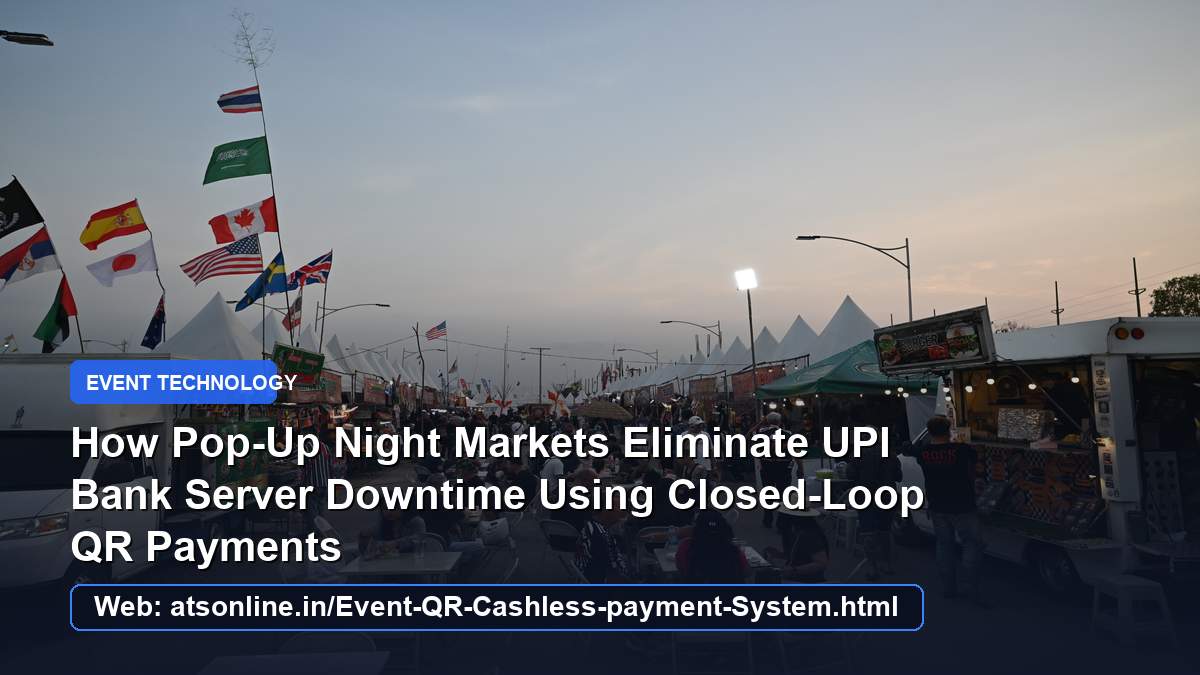
Picture the scene: a sprawling, vibrant night market pulsing with neon lights, the mouthwatering aroma of sizzling street food, and thousands of eager patrons packed shoulder-to-shoulder. Beneath this energetic surface, however, a quiet panic is unfolding at every food stall and artisanal booth. Thousands of festival-goers simultaneously pull out their smartphones to scan standard UPI QR codes, slamming local cellular towers with an impossible volume of data requests. Within minutes, the network buckles under the pressure. Transactions stall indefinitely, screens freeze on the dreaded “Processing Payment” wheel, hungry customers walk away in frustration, and vendors lose thousands of dollars in unrealized revenue. This exact operational nightmare is precisely why modern event organizers are rapidly abandoning traditional public gateways in favor of a dedicated Closed Loop QR Payment System.
For decades, night markets, food truck rallies, and temporary pop-up festivals have struggled with the limitations of public financial infrastructure. Standard payment methods rely heavily on open-loop banking networks, which are notoriously fragile when compressed into high-density geographic spaces. When fifty thousand people congregate in a single three-block radius, standard cellular towers saturate instantly. Consequently, smart event producers are turning toward isolated wallet ecosystems and specialized event technologies like ATS WalletQrPay to guarantee lightning-fast throughput, complete financial reliability, and absolute peace of mind for both vendors and attendees.
The Night Market Crisis: Why Public UPI Networks Collapse Under High-Density Evening Traffic
Public UPI networks and traditional merchant acquiring systems are engineering marvels for distributed daily commerce. Furthermore, they function brilliantly when a few dozen shoppers are buying groceries across a sprawling suburban neighborhood. Unfortunately, their architecture fails catastrophically during high-density evening events. When ten thousand mobile devices ping the exact same regional cell tower simultaneously, bandwidth allocation collapses. As a result, network latency skyrockets, packet loss becomes rampant, and standard UPI server downtime in a night market shifts from a rare anomaly to an absolute certainty.
Consider the devastating financial impact of a typical payment failure during peak festival hours. A vendor might have twenty hungry patrons waiting in line for a freshly prepared artisanal meal. When the payment terminal freezes due to upstream banking congestion, the transaction times out after forty agonizing seconds. The customer tries again, only to experience another timeout. Frustrated, the patron abandons the queue entirely, taking their business elsewhere. Furthermore, the vendor is left with wasted inventory, an agitated crowd, and zero record of a completed sale. Therefore, relying on open-loop banking rails for temporary high-density events is a massive operational gamble.
Understanding the Closed-Loop QR Payment System and How It Operates Independently
To solve the bottleneck of public telecommunications and banking APIs, forward-thinking event organizers rely on an independent financial ecosystem. A Closed Loop QR Payment System completely bypasses traditional third-party banking rails by operating on an isolated, event-specific server network. Attendees pre-load funds into a digital wallet before entering the festival grounds, or they quickly top up their balances at dedicated cash-to-card and top-up kiosks located at the venue entrances.
Once funds reside inside this self-contained digital wallet, every subsequent transaction occurs entirely within the event’s closed ecosystem. When a patron scans a vendor’s QR code to purchase goods, the transaction clears instantly against their pre-loaded event balance. Because the request never travels across public banking switches or congested external gateways, transaction speeds drop to under one second. In addition, this isolation completely eliminates external processing fees, charge-back fraud, and unpredictable downtime caused by remote bank server maintenance.
Beating Cellular Blackouts with Offline and Local Wi-Fi Mesh Capabilities
Even the most advanced software solutions stumble if the underlying physical network infrastructure drops entirely. Night markets frequently occupy unconventional urban spaces, historic plazas, or coastal boardwalks where cellular reception is notoriously weak. Consequently, relying on standard 4G or 5G connections is a recipe for disaster. Modern high-performance platforms utilize local Wi-Fi mesh networks and edge-computing servers deployed directly on-site to maintain absolute operational continuity.
By routing transactional data through a localized, encrypted router network established specifically for the event, the entire festival infrastructure operates independently of external fiber lines. Even if the venue’s main internet connection experiences a complete blackout, the local mesh network ensures that vendor POS terminals continue communicating seamlessly with the central server. For extreme environments, advanced systems even support secure, short-range offline ledger synchronization. This guarantees that your night market cashless payment system remains bulletproof from the moment gates open until the final visitor departs.
Security First: Protecting Revenue with Cryptographically Signed Dynamic QR Badges
Financial ecosystems must maintain absolute integrity, especially in cash-adjacent environments where fraudulent activities can drain vendor revenues. Traditional static printed QR codes glued to vendor counters are exceptionally vulnerable to simple manipulation, tampering, or digital screen-recording exploits. Malicious actors have historically captured static QR codes, replicated them, and redirected funds to unauthorized accounts. To combat this vulnerability, enterprise event software implements advanced security layers.
A sophisticated deployment utilizes cryptographically signed dynamic QR badges that continuously refresh at millisecond intervals. Each generated code contains a unique, time-stamped digital signature validated instantly by the local edge server. If a malicious user attempts to screenshot a badge and reuse it later, the system immediately rejects the payload as expired or invalid. Furthermore, this dynamic approach prevents unauthorized third-party interceptions, ensuring that every single dollar spent by an attendee goes directly into the intended vendor’s ledger.
Key Insight: Utilizing cryptographically signed dynamic QR badges completely eliminates screenshot fraud and static tampering, securing 100% of your event’s daily revenue.
Instant Cashier Verification: Audio Buzzers and Visual Prompts for High-Speed Queues
Speed is the ultimate currency of any high-volume night market or food festival. When vendors are serving hundreds of meals per hour, waiting for manual confirmation screens or text message receipts creates disastrous bottlenecks. Human error compounds this issue, as busy cashiers occasionally misread a pending payment screen as a successful deposit, handing over merchandise before funds actually clear.
To eliminate ambiguity and accelerate line movement, advanced platforms integrate instant hardware and software feedback loops. When a customer completes a scan-and-pay action, the vendor’s POS device triggers an immediate, distinct audio chime accompanied by a bright visual confirmation banner. This instant notification system empowers cashiers to hand over items instantly without breaking rhythm. By reducing average transaction times to under three seconds, vendors can comfortably double their hourly throughput and dramatically increase overall sales volume.
- Instant audio chimes confirm successful transactions without requiring visual inspection.
- High-contrast visual indicators show exact settlement amounts on vendor screens.
- Drastically reduced queue wait times prevent customer walkouts and cart abandonment.
- Elimination of cashier estimation errors and accidental under-collection.
Automated End-of-Night Settlements and Transparent Vendor Payouts
Historically, one of the most stressful aspects of managing a multi-vendor night market has been the manual reconciliation process. At 2:00 AM, exhausted event organizers and frantic vendors gather in dusty back offices to count crumpled cash receipts, reconcile paper tickets, and argue over commission splits. This manual accounting method is notoriously prone to discrepancies, human error, and prolonged payout delays that strain relationships with your vendor community.
A dedicated Closed Loop QR Payment System automates this entire administrative burden down to the click of a single button. As transactions occur throughout the evening, the software automatically logs every sale, deducts predetermined commission percentages or stall fees, and allocates the precise net earnings to each vendor’s digital ledger. The moment the event concludes, automated end-of-night settlements generate transparent, itemized financial reports for every participant. Consequently, vendors receive their payouts quickly and accurately, building immense trust and ensuring high retention rates for your future festival editions.
Implementing ATS WalletQrPay for Your Next Pop-Up Festival or Night Market
Transitioning your upcoming festival from a chaotic, cash-heavy operation into a streamlined, high-efficiency digital showcase requires the right technology partner. Organizing a successful night market demands enterprise-grade reliability, intuitive user interfaces, and robust hardware that withstands demanding outdoor environments. This is precisely why event producers across the region trust ATS WalletQrPay to manage their most critical operational workflows.
Deploying this comprehensive ecosystem is straightforward, scalable, and fully customizable to fit events ranging from small neighborhood weekend bazaars to massive multi-acre culinary festivals. By integrating pre-loaded digital wallets, robust offline networking capabilities, secure dynamic badges, and automated payout calculations, you elevate the entire attendee and vendor experience. To discover how you can completely eliminate transaction failures and maximize your event profitability, take the first step and contact our solutions team today for a personalized platform demonstration.
Key Insight: Modernizing your festival’s financial infrastructure with an automated, closed-loop wallet ecosystem transforms chaotic evening operations into a profitable, stress-free experience for everyone involved.
Frequently Asked Questions About Closed Loop QR Payment System
What is a Closed Loop QR Payment System and how does it prevent UPI server timeouts?
A closed-loop payment system operates entirely within an independent, event-specific digital wallet ecosystem. Unlike open-loop UPI transactions that must route through external banking APIs and congested public cellular networks, closed-loop transactions settle instantly against pre-loaded balances on a local edge server. This architecture completely eliminates third-party banking congestion and prevents server timeouts.
Can ATS WalletQrPay process transactions when cellular internet is completely down?
Yes, absolutely. ATS WalletQrPay utilizes local Wi-Fi mesh networking and on-site edge computing infrastructure. Even if external cellular towers and fiber connections experience a total blackout, the local festival network maintains seamless communication between vendor POS terminals and the central event database, ensuring continuous, uninterrupted transaction processing.
How do secure cryptographically signed QR badges prevent fraud and screen-recording abuse?
Instead of using static printed QR codes that can be easily photographed, copied, or screen-recorded for fraudulent reuse, secure systems deploy dynamic badges that refresh every few milliseconds. Each generated code includes a unique, time-stamped cryptographic signature that validates instantly and expires immediately, making duplication completely impossible.
How does the automated end-of-night settlement calculation work for multiple vendors?
Throughout the event, the software records every transaction in real-time, attributing sales directly to each specific vendor’s digital ledger. At the close of the festival, the system automatically subtracts any pre-arranged commission fees, rents, or utility costs, and generates transparent, itemized financial statements ready for instant electronic payout distribution.
What hardware is required for vendors to accept payments at a pop-up night market?
Vendors do not require expensive proprietary card-swiping terminals. A standard smartphone or tablet running the merchant application is entirely sufficient. Vendors simply display their dynamic cryptographic QR code on their screen or use the device camera to scan customer wallet badges, ensuring a lightweight, cost-effective hardware setup for every stall.
Ready to Modernize Your Event Ticketing?
Stop losing money on unsold coupon booklets and eliminate long lines with on-demand thermal coupon printing.
🏢 Advance Technology Systems (ATS)
🌐 Website: https://atsonline.in/Event-QR-Cashless-payment-System.html
📞 Phone: +91 9810078010
✉️ Email: ats.fnb@gmail.com
💬 Inquiries: Contact Us at Labhak