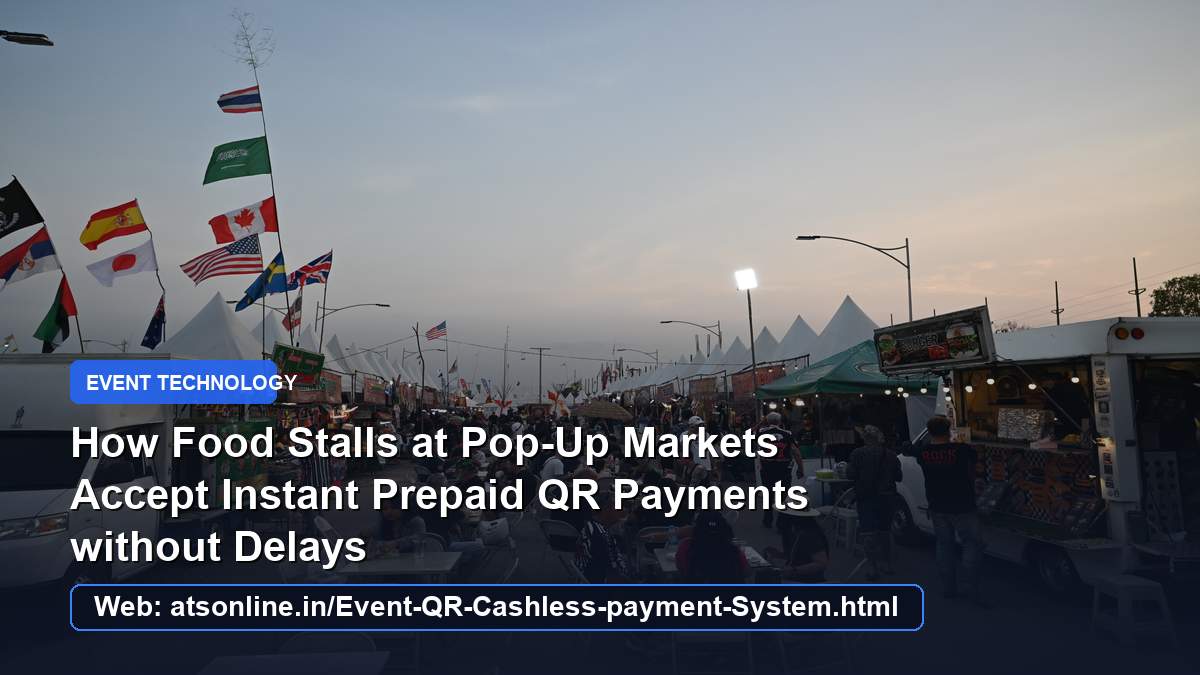
Picture the scene: a sprawling, neon-lit night market where the air smells of sizzling garlic, caramelized sugar, and wood smoke. Thousands of hungry festival-goers crowd the narrow lanes, eager to buy gourmet street food. Yet, behind the stalls, a different kind of drama unfolds. Vendors stare frantically at loading screens, waiting endlessly for UPI apps to process transactions while long queues dissolve into frustration. This bottleneck is precisely why modern food stall operators are turning to prepaid QR code payments to revolutionize event commerce.
Traditional payment rails simply crumble under the extreme network loads typical of outdoor festivals, pop-up food markets, and artisan bazaars. When thousands of people simultaneously ping cellular towers for bank-to-bank transfers, timeouts occur, sales are lost, and customer goodwill evaporates. Fortunately, advanced alternatives like the ATS WalletQrPay Cashless Payment System offer a bulletproof remedy. By decoupling vendor transactions from live banking gateways, this infrastructure guarantees sub-second processing speeds, keeping food stalls moving at lightning speed.
In this comprehensive guide, we will explore how migrating to a dedicated prepaid cashless infrastructure eliminates operational friction. Furthermore, we will examine how robust event technology empowers vendors, secures organizer revenue, and delivers deep real-time analytics for modern pop-up markets.
The Hidden Cost of Slow UPI and Cash Transactions at Pop-Up Food Markets
Cash handling at high-volume food stalls creates hidden operational drags that eat directly into profit margins. Counting physical bills introduces human error, increases the risk of employee theft, and consumes valuable minutes during peak trading hours. Moreover, making change for every transaction slows down service speed dramatically.
On the other hand, standard consumer UPI QR codes and credit card readers present an entirely different set of vulnerabilities. Whenever cellular networks congest at crowded event venues, payment apps fail to load authentication screens. Consequently, hungry patrons walk away to competitor stalls, resulting in immediate revenue leakage for the vendor.
Event organizers also suffer immensely from fragmented payment collection methods. When every individual food stall accepts cash or relies on separate merchant accounts, financial reconciliation becomes an administrative nightmare. Discrepancies take days to resolve, and tracking accurate sales performance across dozens of vendors feels like guesswork.
What Are Prepaid QR Code Payments and How Do They Work?
To understand the power of prepaid ecosystems, we must look at how closed-loop financial models operate. Instead of initiating live bank-to-bank API calls during the purchase, users load funds onto a digital event wallet before they start buying. Alternatively, they can tie a temporary wristband or mobile profile to a central top-up station.
When the customer decides to purchase a meal, they simply present their prepaid identifier. The vendor uses a mobile scanner to deduct the exact amount instantly. Because the funds reside inside a pre-funded local ledger, the transaction clears locally without querying overburdened commercial banking servers.
Key Insight: Implementing prepaid QR code payments shifts the transaction verification process from external banking networks to a high-speed internal ledger, reducing checkout times from thirty seconds to under one second.
This closed-loop approach transforms how pop-up market cashless POS architectures function. By removing external dependencies, vendors experience zero latency, regardless of how many thousands of concurrent users are active on the festival grounds.
Overcoming Network Congestion: Why Local Wallets Beat Bank Servers
Cellular base stations at outdoor festival grounds are notoriously fragile. When 20,000 attendees stream videos, upload photos, and attempt standard mobile payments simultaneously, bandwidth disappears. Standard payment gateways rely heavily on uninterrupted internet connectivity to authorize charges.
In contrast, specialized festival architectures utilize localized edge computing or resilient offline-first syncing protocols. Even if external cell service drops entirely, local wallet frameworks continue processing transactions seamlessly. Data is cached securely and reconciled automatically once connectivity stabilizes.
- Eliminates dependency on unstable local telecom towers during peak hours.
- Removes third-party payment gateway downtime risks.
- Protects revenue streams against sudden internet outages.
- Ensures consistent user experiences across expansive outdoor venues.
Therefore, deploying a dedicated cashless payment system for food stalls is no longer just a luxury—it is an absolute operational necessity for survival in competitive event markets.
Empowering Food Stall Vendors with Multi-Counter Smartphone Scanners
Historically, deploying electronic payment infrastructure meant renting bulky, expensive POS hardware terminals. These machines required complicated setup procedures, dedicated power cables, and frequent troubleshooting by technical support teams.
Modern event wallet QR pay architectures leverage existing consumer technology by transforming standard Android and iOS devices into powerful point-of-sale terminals. Vendors simply download an authorized vendor app, log in securely, and use their smartphone cameras as instant mobile wallet scanners.
- Download the secure vendor application onto any modern smartphone.
- Log in using unique stall credentials provided by the event organizer.
- Enter the order amount or select pre-configured menu items.
- Scan the customer’s prepaid QR code or wristband instantly.
- Hear an audible confirmation tone and hand over the completed food order.
Furthermore, this multi-counter approach allows busy food stalls to deploy multiple queues simultaneously. If one line grows too long, staff members can simply grab a secondary phone and start processing payments from waiting customers further down the line.
Centralized Money Collection: Securing Organizer Revenue and Preventing Theft
For festival producers and night market organizers, financial security is paramount. Managing physical cash across fifty different food vendors creates massive exposure to shrinkage, miscounting, and internal theft. Furthermore, collecting commissions manually at the end of the night is tedious and contentious.
With an integrated cashless ecosystem, all funds flow through a centralized, transparent merchant account managed by the event organizer. Attendees load money upfront at central kiosks, via mobile web portals, or with designated cash-to-card exchange agents. Consequently, cash never sits unprotected inside individual food stalls.
Key Insight: Centralized collection models eliminate cash handling entirely at the vendor level, giving event organizers complete visibility and absolute control over gross revenue distribution.
At the conclusion of the event, payouts are calculated automatically based on immutable digital ledger entries. Organizers deduct commissions instantly and disburse net earnings to vendors without relying on disputable end-of-night paper receipts.
Real-Time Sales Tracking and Live Analytics for Food Stall Operators
Data drives profitability in the modern hospitality industry. Traditional food stalls operating on cash struggle to answer basic operational questions: Which menu item sold the most between 6 PM and 8 PM? Which staff member processed the highest volume of orders?
Using an advanced vendor sales tracking app, operators gain instant access to live cloud dashboards. They can monitor inventory depletion in real time, identify slow-moving items, and adjust ingredient prep schedules dynamically during the event.
- Live revenue tracking broken down by hour, counter, and menu item.
- Instant inventory alerts to prevent stockouts of popular dishes.
- Comprehensive shift reporting for accurate staff performance reviews.
- Automated tax and commission calculations for effortless financial audits.
These powerful analytical insights enable culinary entrepreneurs to optimize their operations on the fly, maximizing revenue during high-traffic weekend pop-ups.
Step-by-Step Implementation Guide for Your Next Pop-Up Market or Food Festival
Deploying a seamless digital payment environment requires careful planning and strategic execution. Whether you are managing a weekend artisan bazaar or a massive multi-day cultural food festival, following a structured roll out plan guarantees success.
First, collaborate with experienced technology providers well in advance to map out your venue layout, estimated attendance, and vendor count. Ensure you deploy enough physical top-up stations so attendees can load their wallets without waiting in long lines.
- Phase 1: Vendor On boarding & Menu Digitization — Collect vendor profiles, upload menu items, and assign unique digital credentials to every participating food stall.
- Phase 2: Staff Training & App Deployment — Conduct brief training sessions for vendor staff on how to use smartphone scanners effectively.
- Phase 3: Attendee Education & Top-Up Setup — Promote pre-event wallet loading via digital ticketing channels and set up prominent physical top-up booths on-site.
- Phase 4: Live Monitoring & Post-Event Settlement — Supervise live transactions through central dashboards and execute automated vendor payouts post-event.
Future-Proofing Night Markets and Artisan Bazaars with Cashless Technology
As consumer expectations shift toward frictionless, contactless digital experiences, traditional cash-only food markets risk losing relevance. Modern diners demand speed, convenience, and absolute transparency when purchasing meals at public events.
Embracing innovative event technology elevates the entire festival atmosphere. Shorter queues lead to happier customers, which directly translates to higher average spend per attendee and increased vendor satisfaction. Ultimately, forward-thinking event organizers who adopt scalable digital wallets will dominate the outdoor hospitality landscape for years to come.
Frequently Asked Questions About Prepaid QR Code Payments
How do prepaid QR code payments eliminate network delay issues at crowded events?
Prepaid QR code systems operate on closed-loop internal ledgers rather than external banking networks. Because funds are pre-loaded onto a digital wallet before the event, transactions are verified locally by the vendor’s device in milliseconds. This bypasses jammed cellular towers and overloaded banking servers entirely, ensuring zero transaction lag even in massive crowds.
Can food stall vendors use their own smartphones as POS payment scanners?
Yes, absolutely. Modern solutions are designed to be hardware-agnostic. Vendors simply download an authorized vendor application onto any standard Android or iOS smartphone, log in with their assigned credentials, and use their phone cameras to scan customer QR codes instantly without needing expensive dedicated POS terminals.
How do event organizers collect and manage money centrally with ATS WalletQrPay?
Attendees load funds into a central digital wallet via online portals, on-site kiosks, or cash-to-card exchange desks before making purchases. All transaction revenues flow directly into a master organizer account. This completely eliminates cash collection at individual stalls, drastically reducing theft risks and simplifying end-of-event financial reconciliation.
Does the system require continuous high-speed internet connectivity at the venue?
No, advanced festival payment systems are built with offline-first synchronization capabilities. Even if venue cellular coverage drops or fluctuates wildly, local transactions continue processing without interruption. Data is safely cached and automatically synced to the cloud whenever a stable connection becomes available.
How does a prepaid wallet system prevent cash theft and short-changing by staff?
By removing physical cash from the equation entirely, the opportunity for employee skimming, pocketing bills, and manual counting errors disappears. Every single sale is digitally logged against a specific vendor account and staff login ID, creating an immutable audit trail that guarantees absolute financial transparency.
Ready to transform your food stalls, night markets, and pop-up festivals with lightning-fast, secure transactions? Explore the complete capabilities of the ATS WalletQrPay Cashless Payment System today. For tailored enterprise pricing and custom event integrations, please contact our solutions team.
Ready to Modernize Your Event Ticketing?
Stop losing money on unsold coupon booklets and eliminate long lines with on-demand thermal coupon printing.
🏢 Advance Technology Systems (ATS)
🌐 Website: https://atsonline.in/Event-QR-Cashless-payment-System.html
📞 Phone: +91 9810078010
✉️ Email: ats.fnb@gmail.com
💬 Inquiries: Contact Us at Labhak