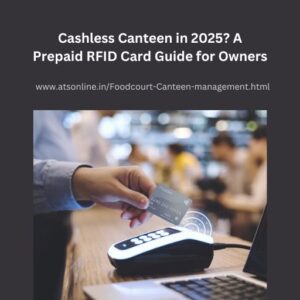
Discover why schools are ditching cash for RFID cashless school canteen system. Boost speed, cut administrative costs, and improve student safety today.
The lunch bell rings, and hundreds of students rush toward the cafeteria. For decades, this daily ritual has been accompanied by a familiar, chaotic soundtrack: the fumbling of coins, the slow exchange of change, dropped money, and the inevitable long queues that eat into valuable break time.
However, a quiet revolution is taking place in educational institutions globally. Schools and universities are rapidly moving away from traditional cash handling and embracing RFID-based cashless payment systems.
While traditional cash or coupon systems may seem simple on the surface, a closer look reveals they are often an “operational drain”. By contrast, modern prepaid card technology offers a smarter, safer, and financially superior alternative. Here is why schools are making the switch to cashless canteens.
1. The Financial Argument: Turning a Cost Center into Capital
The most compelling reason to switch is financial. Many administrators fear the cost of upgrading technology, but the data suggests that sticking with cash is actually more expensive in the long run.
The Hidden Cost of Cash
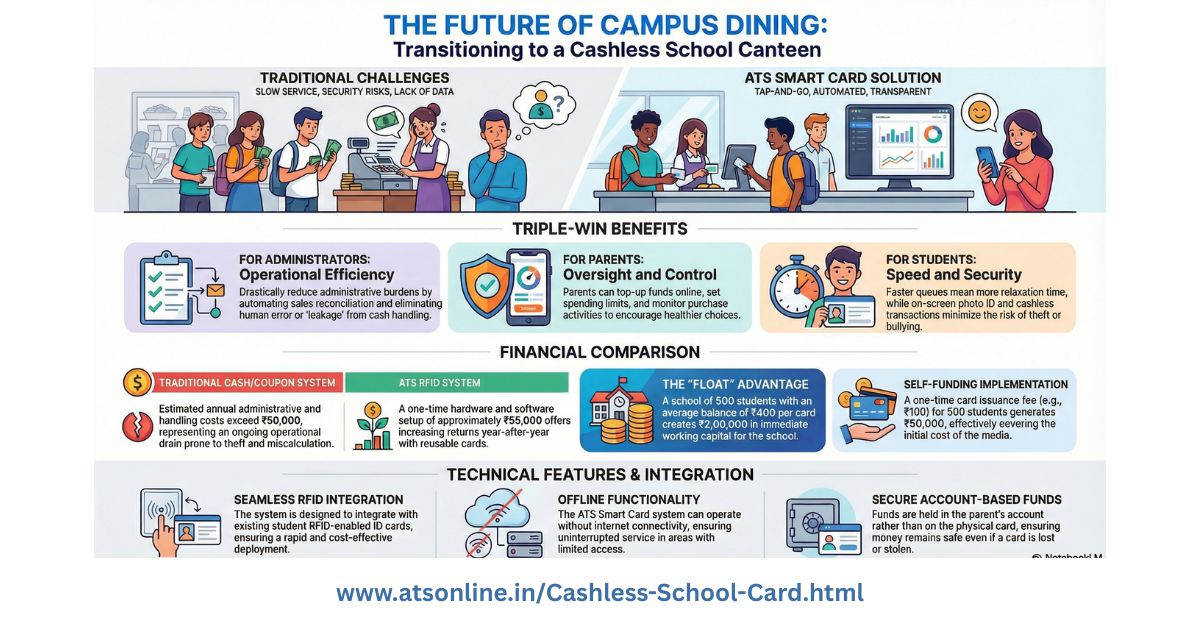
Managing physical currency is hidden work. For a school of roughly 500 students, the annual administrative and handling costs for a manual cash/coupon system can exceed ₹50,000. This money is lost to the time spent counting coins, reconciling drawers, and the daily manual effort required to track sales. Furthermore, cash systems are prone to “financial leakage”—revenue lost to calculation errors, misplaced change, or theft.
The RFID Return on Investment
Conversely, an ATS RFID System setup costs approximately ₹55,000 for hardware and software. While this looks like an initial expense, the system is designed to pay for itself immediately through two clever financial mechanisms:
- Self-Funding Implementation: Schools can implement a one-time card issuance fee (e.g., ₹100) to cover the cost of the media. For 500 students, this instantly generates ₹50,000, effectively covering the initial media costs while teaching students responsibility.
- Creating a “Working Capital Float”: When students or parents preload cards, that money sits in the school’s account until it is spent. If 500 students maintain an average balance of ₹400, the school suddenly has ₹2,00,000 in available cash flow. This immediate liquidity allows the cafeteria to purchase inventory and manage expenses without financial strain, a benefit impossible with daily cash transactions.
2. Speed: Reclaiming the Lunch Hour
The primary frustration for students is the wait. In a manual system, a transaction involves counting money, verifying the amount, and handing back change. This friction causes bottlenecks, especially during peak hours.
RFID systems are built for speed. By introducing a cashless solution, schools can “significantly enhance the overall speed and efficiency of service”. A simple tap of an ID card completes the transaction instantly. This reduction in transaction time slashes queue lengths, ensuring students spend less time standing in line and “more time for relaxation and engaging in activities of their choice”.
3. Safety and Security: Beyond Just Payments
Removing cash from the school environment does more than just speed up the lunch line; it fundamentally changes the campus atmosphere.
Eliminating Bullying and Theft
Cash makes students targets. “Enhanced cash security measures contribute to a safer environment and minimize instances of bullying,” creating a more inclusive atmosphere. When students no longer carry physical currency, the risk of theft and loss is significantly minimized.
Data Security
Modern systems like the ATS Smart Card prioritize identity protection. They feature “on-screen photo ID” during transactions, ensuring that a stolen card cannot be easily used by another student. Additionally, all data is encrypted to prevent unauthorized access, and systems employ robust fraud protection measures.
4. Parental Control and Healthier Choices
In a cash-based system, parents hand their children lunch money and hope for the best. They have no way of knowing if that money was spent on a nutritious meal, sugary snacks, or not spent on food at all.
Cashless systems bridge the gap between home and school. They empower parents with a convenient way to “monitor for purchase activities,” ensuring transparency. Through online portals, parents can:
- Set Spending Limits: Ensure the student budgets correctly.
- Monitor Nutrition: See exactly what is being purchased to “encourage healthier choices”.
- Remote Top-Ups: Load funds via a secure website, removing the morning scramble for loose change.
5. Seamless Integration and Reliability
A common fear among IT administrators is that a new system will require a complete overhaul of existing infrastructure or rely too heavily on unstable internet connections.
The ATS system addresses these concerns head-on. It is designed to “seamlessly integrate with the existing student RF-ID cards,“ meaning schools often do not need to issue new cards if they already have an ID system in place.
Furthermore, reliability is guaranteed regardless of connectivity. The system “can operate offline,” ensuring uninterrupted functionality even in areas with limited internet access. This is critical for university cafeterias or schools where Wi-Fi dead zones could otherwise halt lunch service.
6. Better Data, Less Waste
Finally, the switch to digital payments provides schools with actionable data. “Digital transactions provide detailed data for analysis and decision-making”. Schools can track which items are popular and which are not, leading to better inventory management and “reduced food waste”. Instead of guessing how much food to prepare, canteen managers can rely on historical data to optimize their kitchen operations.
Conclusion
The debate between RFID and cash is no longer just about convenience; it is about accurate financial management, student safety, and operational efficiency. By eliminating the “operational drain” of manual systems and unlocking the power of data and speed, schools can transform their canteens into modern, efficient hubs.
With the ability to integrate into existing ID cards and operate offline, the barrier to entry is lower than ever. It is time for schools to leave the loose change behind and tap into the future.
You can reach us by phone at +91 9810078010 or by email at ats.fnb@gmail.com. Thank you for your interest in our services.
Top 6 Google Search Optimized FAQs
Q1: Is internet connectivity required for the cashless system to work?
A1: No. The ATS Smart Card cashless system can operate offline. This ensures that your canteen service is never interrupted, even if the school’s internet connection goes down or is limited.
Q2: What happens to the money if a student loses their RFID ID card?
A2: The funds are safe. Money is held in the parent’s account, not on the physical card. If lost, the card can be blocked, and the balance remains secure in the account for future use.
Q3: How do parents add money to the student’s prepaid canteen card?
A3: Parents can use a secure Online Portal to top-up via digital payments. Alternatively, schools may provide on-site Kiosks where students can add cash or use bank cards to load funds.
Q4: Do we need to issue new ID cards to use this payment system?
A4: Usually not. The system is designed to seamlessly integrate with existing student RF-ID cards, ensuring a cost-effective and rapid deployment without reissuing media to every student.
Q5: How does this system help reduce bullying in schools?
A5: By removing physical cash from students’ pockets, schools minimize the risk of theft and “lunch money bullying,” creating a safer and more inclusive environment for all students.
Q6: Can parents see what their children are eating for lunch?
A6: Yes. The system empowers parents to monitor purchase activities through an online portal. This transparency helps parents encourage healthier food choices and set daily spending limits.