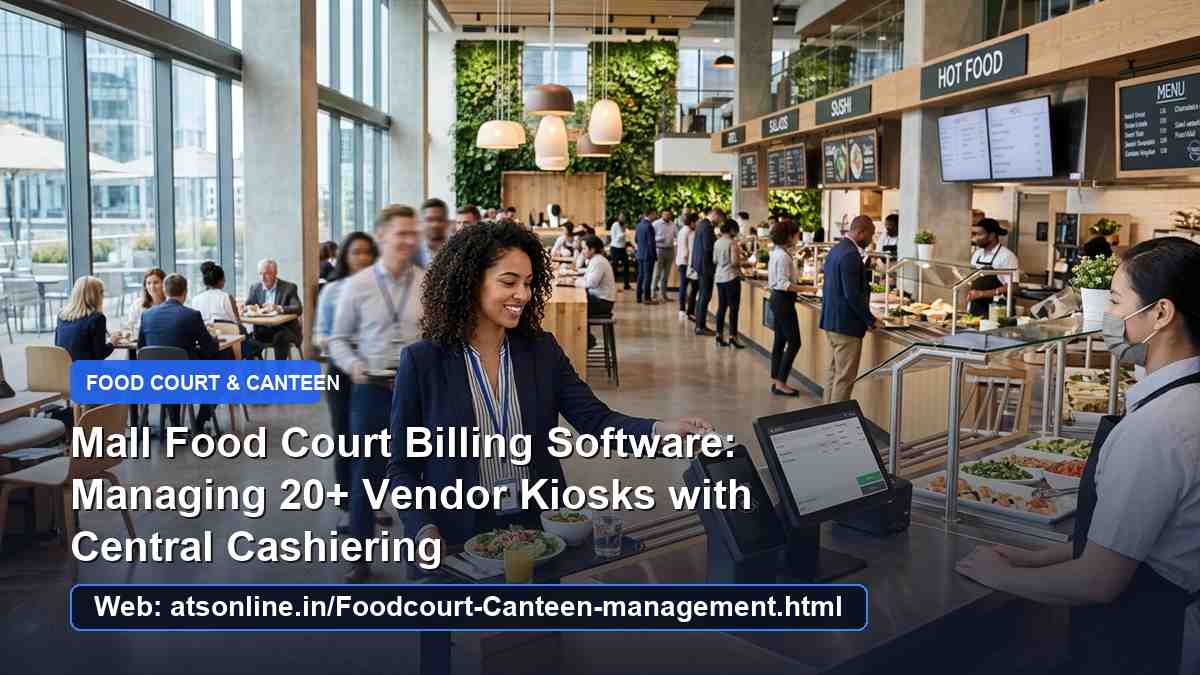
Managing a bustling urban shopping center requires flawless operational synchronization, and nothing tests an operator’s endurance quite like a busy lunch rush. Selecting the right Food Court Billing Software is no longer just a luxury for modern malls; it is the absolute backbone of profitable multi-vendor dining ecosystems. Furthermore, when dozens of independent culinary kiosks share a unified seating space, traditional standalone cash registers inevitably create massive bottlenecks, reconciliation errors, and frustrated customers. To achieve seamless synergy, forward-thinking real estate developers and master concessionaires rely on the ATS Food Court & Canteen POS. Consequently, transitioning from fragmented legacy systems to a centralized multi-vendor POS ecosystem unlocks unprecedented throughput, airtight revenue tracking, and automated financial settlements.
Without centralized control, mall operators often struggle with revenue leakage, cash pilferage, and agonizing end-of-day reconciliation audits. Tenants frequently dispute commission percentages and daily sales reports when numbers are tallied manually. Consequently, modern mall management teams need an integrated Food Court Billing Software suite that enforces strict financial accountability while speeding up customer service queues across every single food kiosk.
The Mechanics of Central Cashiering and Prepaid Smart Cards
The secret weapon of high-volume dining precincts is the central cashiering model paired with prepaid smart cards or digital tokens. Instead of every individual vendor handling cash, credit cards, and mobile wallets, customers load funds onto a centralized smart card or digital QR pass at dedicated recharge counters. Subsequently, guests walk directly up to any food kiosk and tap their card on a compact food kiosk POS terminal to instantly deduct the exact meal cost.
Key Insight: Centralized cashiering drastically reduces transaction times by up to 60%, eliminating the time vendors spend counting change, handling soiled currency, and processing individual credit card authorizations.
Furthermore, this closed-loop payment structure gives master operators total visibility over cash flow before money ever reaches individual tenant accounts. Customers enjoy the freedom of visiting multiple different stalls—such as grabbing an appetizer from one vendor and a beverage from another—using a single unified balance. In addition, unused balances can either be instantly refunded at the central desk or saved for future visits, boosting customer loyalty and repeat mall footfall.
Scaling to 20+ Vendor Kiosks Without Operational Friction
Expanding a dining hall to accommodate twenty, thirty, or even fifty distinct culinary brands requires an infinitely scalable software architecture. As your tenant roster grows, your Food Court Billing Software must effortlessly onboard new vendors without requiring network overhauls. Each kitchen terminal connects via secure local networks or cloud infrastructure to receive instant, direct-to-kitchen print orders the moment a transaction clears.
Here is how modern scalable systems handle rapid expansion:
- Instant menu updates and dynamic pricing adjustments pushed remotely from the central management console to all kitchen display screens.
- Modular hardware integration, allowing new food kiosk POS terminal units to plug into the central database within minutes.
- Customizable user access permissions ensuring kitchen staff only see order details, while managers access sensitive financial data.
- Isolated vendor profiles that prevent overlapping inventories and ensure clean demarcation of distinct culinary brands.
Consequently, operators can rotate pop-up vendors and seasonal food trucks in and out of vacant stalls with minimal administrative downtime. This plug-and-play agility ensures that your food hall remains vibrant, trendy, and highly responsive to shifting consumer dining preferences.
Automated Tenant Settlements and Commission Deductions
Calculating weekly or monthly revenue shares for dozens of independent restaurant tenants is notoriously tedious and prone to costly disputes. Fortunately, sophisticated tenant settlement system modules automate this entire financial workflow from end to end. Every time a customer taps their card at a vendor’s stall, the software instantly logs the gross sale, automatically deducts the mall’s pre-agreed commission percentage, and records net earnings.
Moreover, automated payout engines generate transparent, audit-ready statements that itemize credit card processing fees, utility deductions, and promotional discounts. For example, if a mall runs a weekend discount voucher program, the software proportionally credits each participating vendor. Therefore, finance departments save hundreds of man-hours every month, and tenant grievances regarding delayed or inaccurate payouts vanish completely.
Ensuring High-Speed Billing with Offline-Resilient POS Architecture
Internet downtime in a bustling shopping center can bring business to a screeching halt if your software relies entirely on uninterrupted cloud connectivity. However, enterprise-grade offline food court billing solutions utilize hybrid architectures that keep operations humming even during network outages. Local terminal caching ensures that smart card validation and receipt printing continue locally without missing a beat.
Key Insight: Hybrid offline-online synchronization guarantees that local database nodes automatically reconcile and sync with the central cloud repository the exact microsecond internet connectivity is restored.
Furthermore, this redundancy protects mall operators from devastating revenue losses during unexpected broadband disruptions. Customers experience zero lag when ordering, and kitchen printers continue firing orders uninterrupted. In addition, robust data encryption ensures that all offline transaction logs remain secure against tampering or data corruption until cloud synchronization completes.
Real-Time Analytics and Live Dashboard Insights
Data-driven decision-making separates thriving culinary destinations from struggling food halls that rely on guesswork. A top-tier food court management software provides executives with comprehensive, real-time dashboard analytics accessible from any mobile device or desktop computer. Mall operators can track peak dining hours, top-performing cuisine categories, and individual vendor velocity live as sales occur.
Key metrics monitored by advanced dashboards include:
- Real-time gross and net revenue streams broken down by hour, day, week, and specific tenant stalls.
- Average customer wait times and order fulfillment speeds across different kitchen counters.
- Smart card circulation volumes, active card balances, and total unredeemed float capital.
- Inventory depletion rates and bestselling menu items to help tenants optimize food prep schedules.
Consequently, marketing teams can use these granular insights to launch targeted happy-hour promotions or design loyalty programs that drive traffic to under performing vendors during off-peak afternoon hours.
Key Benefits of Implementing Modern Food Court Billing Software
Investing in a state-of-the-art multi-vendor POS ecosystem delivers immediate, measurable returns on investment across every single operational pillar. First and foremost, customer satisfaction skyrockets due to dramatically shorter queue times and frictionless payment methods. Furthermore, master concessionaires eliminate cash leakage and administrative overhead, turning error-prone accounting departments into streamlined financial powerhouses.
In addition, tenants appreciate the absolute transparency of automated revenue sharing and precise sales tracking. When restaurants trust the accuracy of their daily settlements, landlord-tenant relationships flourish, leading to higher lease renewal rates and a stable, thriving dining ecosystem. Ultimately, deploying industry-leading tools like the ATS Food Court & Canteen POS positions your property as a technologically advanced, highly efficient commercial leader.
Frequently Asked Questions About Food Court Billing Software
How does central cashiering work in a multi-vendor food court?
Central cashiering replaces individual cash registers at each food stall with centralized recharge counters and digital kiosks. Customers load cash or digital funds onto a prepaid smart card or scan a dynamic QR pass. When ordering food, the customer taps their card at the vendor’s terminal, which instantly deducts the meal price, logs the sale, and sends a digital order directly to the kitchen display screen.
Can the food court billing software operate without an active internet connection?
Yes, enterprise-grade systems feature robust offline-resilient architecture. Local terminals cache card balances and transaction data locally on secure hardware nodes. This ensures that billing, smart card validation, and kitchen receipt printing continue uninterrupted during broadband outages, automatically syncing with the central cloud database once connectivity is restored.
How are daily sales and commissions automatically settled for 20+ tenants?
The integrated tenant settlement module tracks every transaction down to the individual vendor ID. The software automatically calculates gross earnings, subtracts pre-configured mall commission percentages, and generates automated, itemized payout statements. This eliminates manual ledger errors and accelerates weekly or monthly financial disbursements to all participating merchants.
What payment methods do the central recharge cash desks support?
Modern recharge terminals accommodate a comprehensive array of payment instruments to maximize guest convenience. These typically include cash, major credit and debit cards, contactless NFC payments, popular mobile wallets (such as Apple Pay and Google Pay), and UPI or QR-code based peer-to-peer transfers.
How does a smart card or digital QR pass system improve customer turnaround times?
Smart cards and digital passes drastically slash transaction times by eliminating the need for cash handling, exact change calculation, and individual card authorization delays at food stalls. A simple tap takes less than a second, allowing vendors to serve up to three times as many customers per hour during intense peak lunch rushes.
Ready to revolutionize your dining precinct and eliminate administrative bottlenecks? Transform your property’s operational efficiency today by reaching out to our enterprise experts. To discuss your specific layout and scaling requirements, please contact our solutions team or visit the Labhak Contact Page to schedule a personalized live software demonstration.
Ready to Modernize Your Event Ticketing?
Stop losing money on unsold coupon booklets and eliminate long lines with on-demand thermal coupon printing.
🏢 Advance Technology Systems (ATS)
🌐 Website: https://atsonline.in/Foodcourt-Canteen-management.html
📞 Phone: +91 9810078010
✉️ Email: ats.fnb@gmail.com
💬 Inquiries: Contact Us at Labhak