
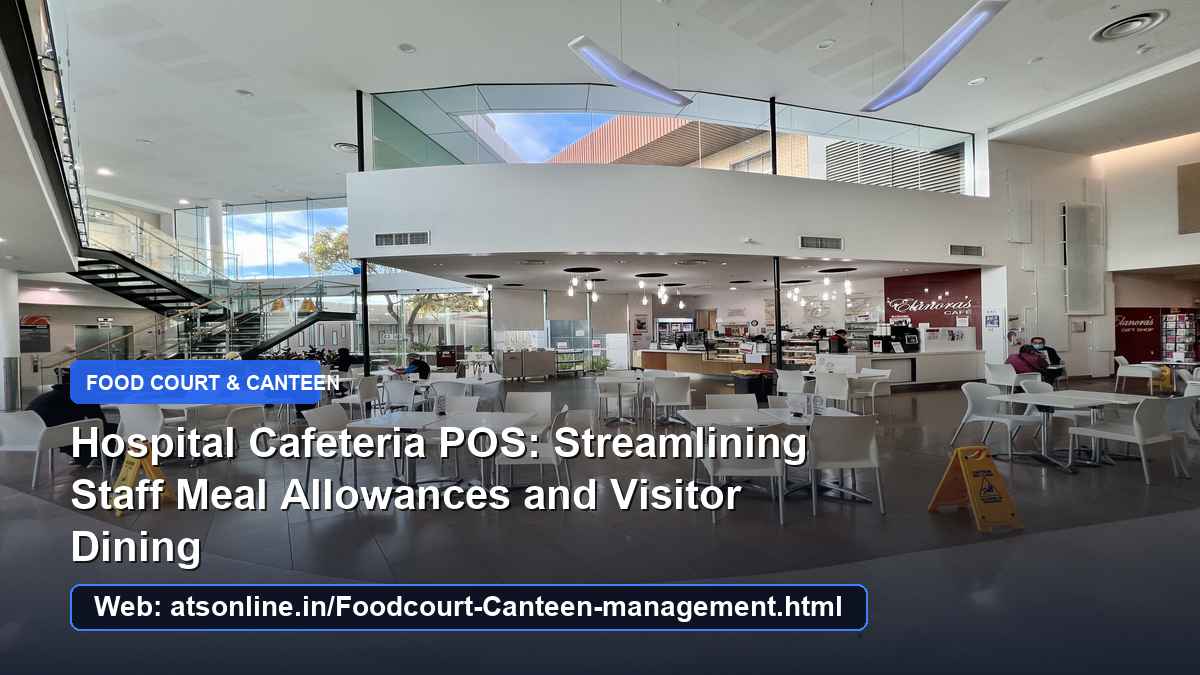
Running a hospital food service operation is one of the most demanding logistical challenges in the entire hospitality sector. Behind every successful healthcare facility stands a robust Hospital Cafeteria POS capable of feeding doctors, nurses, administrative staff, and visitors around the clock. Furthermore, hospital canteens must juggle heavily subsidized staff meals, dynamic shift schedules, dietary compliance, and rapid retail checkouts simultaneously.
Traditional cash registers and generic retail point-of-sale platforms simply cannot cope with these specialized healthcare demands. Consequently, modern hospitals are upgrading to an advanced hospital canteen management system designed specifically to automate subsidies, integrate payroll deductions, and optimize catering workflows. In this comprehensive guide, we examine how next-generation food court technology transforms staff dining and elevates institutional efficiency.
The Complexity of Managing Staff Meal Allowances and Payroll Deductions
Healthcare institutions often provide meal subsidies or complimentary allowances to retain medical talent and support staff working grueling shifts. However, tracking these allowances manually leads to rampant fraud, lost vouchers, and administrative bottlenecks. Therefore, implementing a specialized staff meal allowance software module becomes essential for accurate accounting and transparent subsidy management.
Modern platforms integrate directly with employee biometric databases, smart ID badges, and RFID wristbands. When a nurse purchases lunch, the system instantly authenticates their employee profile and applies the correct tier of meal subsidy. Consequently, any remaining balance or out-of-pocket expenses route directly into payroll deduction cafeteria billing systems for automated month-end salary processing.
- Instant identification via RFID cards, barcodes, or biometric fingerprint scanners.
- Real-time tracking of daily, weekly, or monthly employee meal allowances.
- Automated calculation of subsidized rates versus retail pricing tiers.
- Seamless export of monthly balance deductions directly to HR and payroll software.
Dual-Mode Billing: Balancing Staff Subsidies and Visitor Retail Payments
Hospital dining spaces serve two vastly different demographic groups under one roof: hospital personnel and visiting families. While hospital staff utilize corporate allowances or employee accounts, visitors require standard retail purchasing options like cash, credit cards, and mobile wallet payments. Therefore, a premier Healthcare POS system must feature dynamic dual-mode billing.
Cashiers should never have to manually calculate price differences or switch between separate terminals for different customer types. Instead, modern hospital food court software automatically detects the scan type and switches billing logic instantly. For instance, scanning an employee badge triggers internal ledger accounting, whereas scanning a visitor’s mobile payment opens the digital merchant gateway.
Key Insight: Dual-mode billing eliminates checkout delays by instantly distinguishing between internal subsidized staff accounts and external cash-paying visitors on a single unified terminal.
Ensuring 24/7 Continuous Operation for Night-Shift Healthcare Workers
Hospitals never sleep, which means staff canteens must remain operational during unconventional hours, including overnight shifts and weekends. During these off-peak hours, network instability or internet service provider outages can paralyze legacy cloud-only point-of-sale setups. Consequently, forward-thinking hospital administrators demand a resilient offline POS for hospitals to guarantee uninterrupted food service.
An enterprise-grade offline architecture allows local terminals to process badge scans, manage subsidy limits, and store transaction records securely without active cloud connectivity. As soon as the internet connection restores, the system synchronizes all transaction data back to the central server automatically. Therefore, night-shift clinicians never experience service disruptions, and dining room revenues remain fully accounted for.
Integrating IPD Patient Diet Meal Orders and Ward Delivery Tracking
Staff cafeterias frequently double as central production kitchens responsible for preparing meals for Inpatient Department (IPD) wards. Managing patient nutrition requires strict adherence to clinical prescriptions, allergen restrictions, and doctor-approved therapeutic diets. Thus, integrating dedicated dietary management software into your canteen ecosystem is vital for patient safety and operational accuracy.
Nurses and clinical dietitians can input patient meal requests directly through a centralized terminal linked to the kitchen prep area. The system flags contraindications, such as low-sodium requirements or diabetic meal parameters, preventing catastrophic dietary errors. Furthermore, ward delivery tracking modules provide real-time updates so staff know precisely when a meal tray reaches the patient’s bedside.
Eliminating Paper Waste and Automating Caterer Billing Reconciliation
Many hospitals outsource their food and beverage operations to third-party hospitality vendors while retaining oversight of the facilities and billing infrastructure. This arrangement often results in tedious paper audits, disputed voucher counts, and delayed financial settlements. Fortunately, automated caterer billing reconciliation tools resolve these operational frictions completely.
Every transaction processed through the POS creates an immutable digital ledger categorized by vendor, item category, and subsidy type. At the end of the billing cycle, administrators generate comprehensive financial reports with a single click. In addition, transparent digital ledgers build stronger, more collaborative partnerships between hospital management and external food service contractors.
- Centralized reporting dashboards showing item-wise sales by vendor and counter.
- Automated commission calculations and revenue-sharing audits.
- Elimination of paper receipts, manual logbooks, and human counting errors.
- Instant generation of tax-compliant invoices and financial settlement statements.
Key Factors to Consider When Choosing a Hospital Canteen Management System
Selecting the right technology partner requires evaluating software scalability, security protocols, and hardware durability. Hospital environments demand heavy-duty touchscreens that withstand frequent sanitation and continuous daily use. Furthermore, software compliance with healthcare data privacy regulations is non-negotiable when handling employee and patient records.
- Hardware Resilience: Invest in spill-resistant, medical-grade POS terminals capable of enduring rigorous daily cleaning protocols.
- Integration Capabilities: Ensure the software connects effortlessly with your existing hospital ERP, HR payroll, and active directory systems.
- User Interface Speed: Look for lightning-fast touch menus that minimize queue times during frantic 30-minute lunch shifts.
- Vendor Support: Partner with technology providers offering dedicated 24/7 technical assistance and rapid on-site maintenance response.
Key Insight: Choosing a specialized Hospital Cafeteria POS ensures compliance with clinical dietary standards while drastically reducing the administrative burden on hospital human resources.
Conclusion and Future of Smart Hospital Dining Infrastructure
Streamlining staff dining in a modern healthcare facility is no longer just about serving food quickly; it is about creating a secure, synchronized, and transparent ecosystem. By deploying an advanced hospital canteen management system, hospitals empower their medical heroes with seamless dining experiences while optimizing internal administrative workflows. From automated payroll deductions and dual-mode visitor billing to robust offline resilience and dietary tracking, smart technology secures the backbone of institutional nutrition. Are you ready to revolutionize your healthcare dining operations? We invite you to contact our solutions team today to schedule a personalized software demonstration and discover how tailored technology can transform your facility.
Frequently Asked Questions About Hospital Cafeteria POS
How does a Hospital Cafeteria POS handle staff meal allowances?
The system integrates directly with employee databases, smart badges, or biometric scanners. When a staff member makes a purchase, the POS instantly checks their remaining monthly allowance or subsidy tier, applies the discounted rate, and records the transaction for automated payroll processing.
Can the hospital canteen POS system operate during internet outages?
Yes, enterprise-grade solutions feature robust offline modes. Local terminals continue processing badge scans, verifying meal subsidies, and storing transaction data locally without cloud connectivity. Once the network restores, all data synchronizes automatically with the central server.
How does dual-mode billing work for staff and patient visitors?
Dual-mode billing automatically distinguishes between internal personnel and external visitors based on the payment identifier used. Scanning an employee ID routes the transaction to internal ledgers and subsidies, whereas scanning a credit card or mobile wallet initiates standard retail payment processing on the same terminal.
Does the software simplify monthly billing for third-party caterers?
Absolutely. The platform automatically tracks itemized sales across different food stalls and vendors. At month-end, the software generates accurate reconciliation reports, commission calculations, and financial statements, eliminating tedious paper audits and manual voucher counting.
How are IPD patient diet orders integrated into the cafeteria POS?
Inpatient diet orders are managed through integrated dietary modules where clinical staff input patient nutritional requirements. The system cross-references medical restrictions, manages central kitchen preparation queues, and tracks ward delivery status to ensure safe and timely meal service.
Ready to Modernize Your Event Ticketing?
Stop losing money on unsold coupon booklets and eliminate long lines with on-demand thermal coupon printing.
🏢 Advance Technology Systems (ATS)
🌐 Website: https://atsonline.in/Foodcourt-Canteen-management.html
📞 Phone: +91 9810078010
✉️ Email: ats.fnb@gmail.com
💬 Inquiries: Contact Us at Labhak


