
Welcome to the ultimate guide on modern Food Court Management. Whether you operate a bustling university cafeteria, an expansive corporate dining hall, or a multi-vendor entertainment hub, managing rapid-fire transactions under immense time pressure is a monumental challenge.
Operators frequently struggle with long queues, manual billing errors, and agonizing reconciliation delays. Fortunately, deploying an advanced event coupon printing solution or a robust software ecosystem completely revolutionizes how food courts operate daily.
In this comprehensive guide, we will explore why modern enterprises rely on specialized solutions like the ATS EventCouponPrint platform to streamline operations. We will examine offline-first architecture, cashless RFID technology, automated multi-vendor reconciliation, and strategies to eradicate cash pilferage permanently.
Understanding Modern Food Court Management and Operational Bottlenecks
High-volume dining areas experience intense traffic spikes, particularly during the standard 12:00 PM to 2:00 PM lunch window. Traditional standalone cash registers simply cannot keep pace with ravenous crowds demanding instant service.
When multiple food stalls operate under one roof, customers expect a unified ordering experience. However, disparate legacy systems create friction, forcing patrons to wait in separate queues just to purchase a drink and a main course.
Furthermore, managing inventory and payouts across dozens of independent culinary vendors requires surgical precision. Without centralized oversight, administrative overhead skyrockets, leading to costly accounting discrepancies and frustrated vendor partnerships.
Consequently, forward-thinking operators are abandoning fragmented legacy methods. They are embracing integrated technological infrastructures designed specifically to handle high-density commercial catering environments.
Why Offline-First Architecture is Critical for Peak Lunch Hour Rush
Cloud-dependent software solutions seem modern, yet they introduce severe operational vulnerabilities. When local internet connections drop or broadband speeds throttle during peak hours, cloud POS terminals freeze instantly.
An unexpected internet outage halts every single transaction, turning a profitable lunch rush into an absolute operational disaster. Long queues stall, hungry customers walk away in frustration, and daily revenue plummets.
This is precisely why adopting an offline POS for food court environments is non-negotiable for enterprise resilience. An offline-first infrastructure ensures that local terminals continue processing billing requests, RFID scans, and ticket printouts without missing a beat.
Once connectivity is restored, local data synchronizes seamlessly with the central database in the background. Therefore, your business achieves absolute reliability, ensuring uninterrupted revenue generation regardless of external network stability.
Key Insight: Relying solely on cloud-dependent POS terminals during peak dining hours exposes your business to catastrophic revenue loss when internet connectivity inevitably fluctuates.
The Power of Cashless Transactions: RFID Smart Cards and Wristbands
Speed is the ultimate currency in modern commercial catering. Traditional paper money exchange slows down checkout lines significantly as cashiers count bills and return loose change.
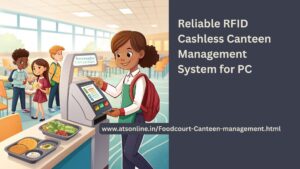
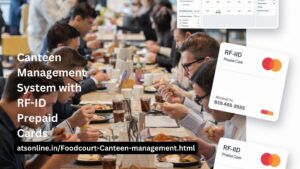
Implementing a smart card canteen system or deploying NFC-enabled wristbands eliminates these bottlenecks entirely. Customers simply tap their credential against a rugged terminal, and the exact balance deducts in milliseconds.
This frictionless tap-and-pay mechanism drastically reduces average service time per customer. Furthermore, it empowers patrons to pre-load funds digitally or link their cards directly to corporate employee accounts.
Here are the primary operational benefits of transitioning to a cashless environment:
- Lightning-fast checkout speeds that dramatically shorten peak-hour queues.
- Complete eradication of counterfeit currency and manual counting errors.
- Enhanced hygiene by eliminating dirty physical banknotes at food prep counters.
- Increased average spend per customer driven by frictionless micro-transactions.
Multi-Vendor Settlement and Automated Daily Reconciliation
Operating a multi-vendor food court involves complex financial gymnastics at the end of each business day. Calculating individual earnings, deducting commissions, and distributing payouts manually is exhausting work.
A sophisticated multi vendor food court POS automates this entire financial lifecycle. Every single item sold at a specific stall is instantly cataloged and credited to that vendor’s digital ledger.
At closing time, managers generate comprehensive settlement reports with a single click. This level of automation guarantees absolute financial transparency and eliminates disputes between management and stall owners.
In addition, streamlined food court billing software generates precise tax summaries, inventory depletion logs, and gross margin analytics. Management teams can thus make data-backed decisions regarding lease renewals, menu pricing, and popular cuisine trends.
Eliminating Cash Pilferage and Food Theft in Canteens
Internal shrinkage remains one of the most persistent financial drains in institutional catering and corporate cafeterias. Unmonitored cash drawers and informal paper ticketing systems invite theft and unauthorized discounting.
When cash handlers operate without rigorous digital oversight, discrepancies frequently appear during shift changes. Dishonest practices such as unrecorded cash sales or unauthorized free meals eat directly into your bottom line.
Deploying a centralized canteen management system closes these security loopholes permanently. Every transaction requires digital authentication, leaving a transparent audit trail tied to specific user credentials.
Management gains real-time visibility into drawer openings, voided transactions, and manual discounts. Consequently, accountability is restored across all shifts, ensuring that every single meal served translates directly into recorded revenue.
Hardware Compatibility: Rugged POS Terminals and Mobile Devices
Software is only as effective as the physical hardware running it. Food courts are demanding environments characterized by airborne grease, moisture, accidental spills, and heavy physical usage.
Investing in industrial-grade touch screen terminals and handheld ordering devices is essential for long-term operational durability. These ruggedized units withstand harsh kitchen conditions without suffering performance degradation.
Modern corporate cafeteria management systems integrate smoothly with a wide array of peripheral hardware:
- High-speed thermal receipt and kitchen order printers (KOT).
- Desktop and wall-mounted RFID card readers and biometric scanners.
- Cash drawers with automated kick-solenoids linked to secure user logins.
- Handheld mobile POS units for roving queue-busting and table-side ordering.
Key Insight: Durable, industrial-grade hardware paired with resilient offline software ensures your checkout counters remain operational even in the most demanding commercial kitchen environments.
How to Choose the Right Food Court Management System for Your Business
Selecting the ideal technology partner requires careful evaluation of your specific operational scale and future growth projections. Not all software packages offer the deep customization required for enterprise-grade deployments.
You must prioritize solutions that provide absolute data ownership, robust offline redundancy, and intuitive user interfaces for cashiers. Training staff quickly on a new system minimizes transition friction during busy operational periods.
Here is a step-by-step checklist to guide your software selection process:
- Audit your current transaction volume, peak hour bottlenecks, and hardware infrastructure.
- Verify that the candidate platform supports robust offline-first architecture to protect against internet outages.
- Evaluate multi-vendor capabilities, ensuring automated revenue splitting and granular settlement reports.
- Test the speed and reliability of RFID smart card or wristband integrations.
- Review customer support availability, software update frequencies, and vendor reputation.
Frequently Asked Questions About Food Court Management
How does a food court management system work without internet connectivity?
An offline-first platform stores all transaction data, menu inventories, and user balances on a secure local terminal or on-premise server. During an internet outage, the system continues processing RFID taps, printing kitchen tickets, and completing sales locally. Once network connectivity returns, the local database synchronizes automatically with cloud backups, ensuring zero data loss and uninterrupted operations.
What are the benefits of using RFID wristbands in corporate canteens?
RFID wristbands offer ultimate convenience and hygiene in high-volume corporate cafeterias. Employees wear them comfortably throughout the workday, eliminating the need to carry wallets, ID cards, or cash. This wearable technology drastically accelerates checkout speeds, prevents loss of physical cards, and encourages higher adoption of cashless workplace dining programs.
How does multi-vendor settlement work at the end of the day?
Throughout the operating day, the POS software tags every single item sold with the specific vendor identifier responsible for preparation. At closing time, the system automatically aggregates these sales, calculates agreed-upon commission percentages or rental deductions, and generates individual payout reports for each stall owner. This eliminates hours of manual spreadsheet compilation and prevents financial disputes.
Can the canteen POS system integrate with existing thermal printers and hardware?
Yes, enterprise-grade management solutions are designed with universal hardware compatibility in mind. They connect seamlessly with standard industrial thermal receipt printers, kitchen display systems (KDS), cash drawers, barcode scanners, and various models of RFID card readers, allowing businesses to leverage their existing hardware investments.
How does a cashless system prevent cash pilferage and food theft?
Cashless architectures eliminate unmonitored physical currency exchanges and informal paper ticket issuances. By requiring every meal to be purchased via digital employee accounts, smart cards, or pre-loaded RFID credentials, the software creates an immutable audit trail. Management can track every transaction down to the exact second, staff member, and terminal, making internal theft virtually impossible.
Conclusion and Future of Automated Canteen Operations
Mastering Food Court Management is no longer just about serving food quickly; it requires an intelligent, resilient technological foundation. From weathering unexpected internet outages with offline-first POS architecture to eliminating cash shrinkage through RFID smart cards, modern tools redefine enterprise hospitality standards.
By automating multi-vendor settlements and streamlining peak-hour billing, businesses unlock unprecedented operational efficiency and higher profit margins. Embracing these advanced innovations positions your establishment at the absolute forefront of modern dining convenience.
Are you ready to transform your cafeteria operations, eradicate queue bottlenecks, and secure your daily revenue? We invite you to contact our solutions team today to schedule a personalized demonstration and discover how tailored technology can elevate your business to new heights.
Ready to Modernize Your Event Ticketing?
Stop losing money on unsold coupon booklets and eliminate long lines with on-demand thermal coupon printing.
🏢 Advance Technology Systems (ATS)
🌐 Website: https://atsonline.in/Foodcourt-Canteen-management.html
📞 Phone: +91 9810078010
✉️ Email: ats.fnb@gmail.com
💬 Inquiries: Contact Us at Labhak