Picture this: It is a bustling Saturday night at your flagship restaurant. The dining room is packed to capacity, the ambient noise of clinking glasses fills the air, and your front-of-house staff are sprinting between tables. Amidst this high-energy chaos, a tired server scribbles down a complex order on a tattered paper pad. Ten minutes later, a sizzling plate lands on a table, only for an irritated guest to point out that they requested their steak medium-rare, not well-done, and with mushroom sauce instead of peppercorn. This scene plays out in kitchens worldwide, highlighting why implementing a modern table ordering system is no longer optional for high-performing venues. Human errors during order taking destroy food cost margins, frustrate guests, and exhaust your team.
Fortunately, cutting these operational bottlenecks by up to 80% is entirely achievable with advanced technology. In this exhaustive guide, we explore how transitioning to digital ordering workflows transforms your service standards. By modernizing your front-of-house with specialized tools, your business can unlock new levels of speed, accuracy, and profitability.
Introduction to Restaurant Order Errors and Their Financial Impact
Order mistakes are the silent profit killers of the modern hospitality industry. When a server misinterprets handwriting or forgets to note a dairy allergy, the cascading effects eat directly into your bottom line. First, the incorrect dish must be remade from scratch, wasting expensive ingredients and burning precious kitchen labor time. Second, the disgruntled customer requires compensation, free rounds of drinks, or heavily discounted bills to salvage the guest relationship. Third, your table turnaround time plummets as frustrated patrons wait twice for their meals.
Furthermore, these avoidable mistakes create immense friction between front-of-house and back-of-house staff. Waiters blame kitchen personnel for not reading tickets closely, while chefs point fingers at sloppy handwritten pads. Consequently, employee morale drops, leading to higher turnover rates in an already tight labor market. To eliminate this friction, forward-thinking operators are abandoning legacy methods and investing in robust restaurant POS software designed for modern dining environments.
Key Insight: Studies show that up to 15% of all traditional paper-based restaurant orders contain at least one error, ranging from omitted modifiers to entirely wrong table numbers.
The Evolution from Paper Pads to a Digital Table Ordering System
For decades, the standard operating procedure for taking orders relied on paper pads, pens, and memory. While this method worked in simpler times, today’s fast-paced dining landscape demands unprecedented speed and precision. A modern table ordering system replaces physical pads with sleek handheld devices, mobile order-taking apps, and cloud-synchronized databases.
When a server taps items into a mobile order taking app at the bedside, the data transmits instantly across the establishment’s secure network. There is no need for runners to physically carry paper tickets across a crowded room. In addition, digital interfaces prompt servers through mandatory selection prompts, ensuring they never forget to ask essential questions like meat temperatures or side dish choices before submitting.
Here is how the digital ordering workflow fundamentally outperforms paper:
- Zero Legibility Issues: Kitchen staff never have to decode messy handwriting or faded ink.
- Instantaneous Transmission: Orders reach the preparation line in milliseconds rather than minutes.
- Interactive Menus: Servers can view real-time item availability, preventing them from selling out-of-stock dishes.
- Guided Selling: Upselling prompts appear on screen, encouraging staff to suggest drink pairings and premium add-ons.
How Automated KOT Printing Bridges the Gap Between Floor and Kitchen
Once an order is captured at the table, the next critical step involves communicating that information to the chefs and barmen. Traditional systems often relied on a loud shouting match across the pass or chaotic paper spikes. Today, reliable KOT printing software automates this entire communication pipeline with absolute precision.
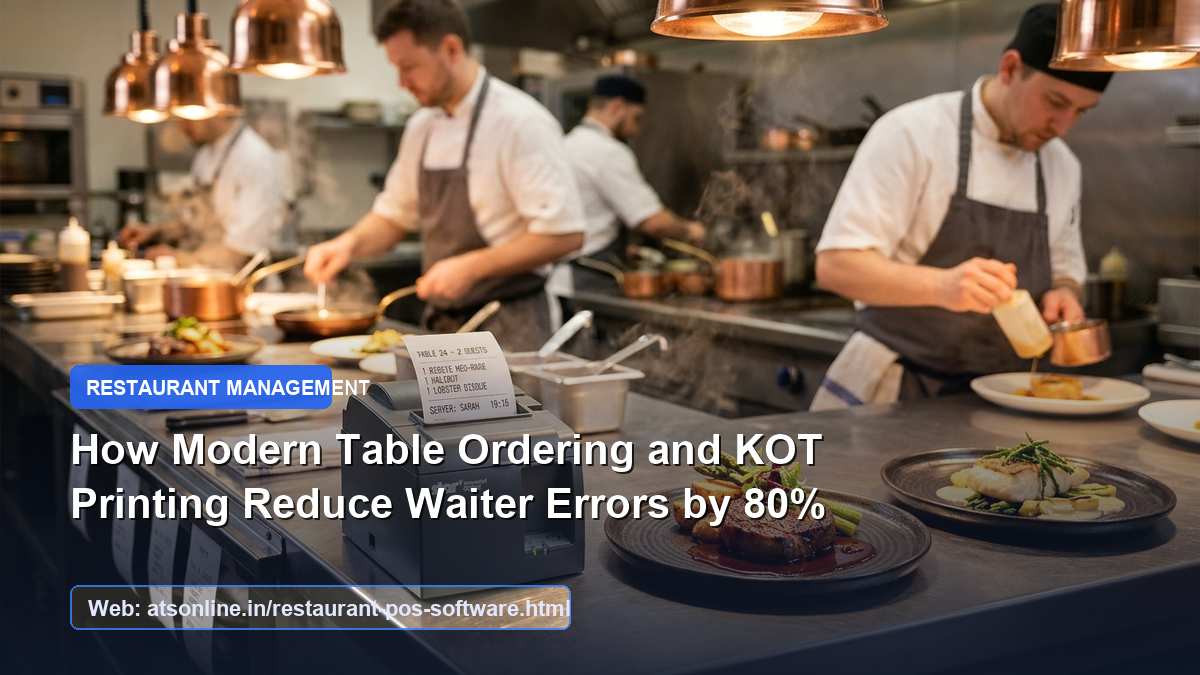
Using advanced thermal KOT printer hardware strategically placed around the kitchen, different food categories route automatically to their respective stations. For example, appetizers print directly on the cold station printer, steaks route to the grill line, and cocktail orders fire instantly to the bar. This intelligent routing ensures that every member of the culinary team sees clear, organized tickets simultaneously.
Furthermore, integrating a wireless KOT system eliminates the physical limitations of stationary POS terminals. Servers no longer crowd around a single computer screen to punch in orders, which drastically reduces queue times during peak service hours. By streamlining this crucial hand-off, kitchens operate with surgical efficiency and dramatically fewer mistakes.
Eliminating Misunderstandings with Modifier and Special Instruction Support
Dietary restrictions, allergies, and specific customer preferences are increasingly common in contemporary dining. Handling these nuances on paper is notoriously difficult, often resulting in dangerous or unpalatable mistakes. A well-designed digital ordering framework handles complex modifiers seamlessly through structured touchscreen menus.
When a guest requests a gluten-free pizza crust with extra vegan cheese and no onions, the server simply taps the corresponding modifiers within the captain app. These modifications appear highlighted on the kitchen ticket, ensuring complete clarity for the line cooks. Consequently, guests receive meals tailored precisely to their liking, building immense trust and brand loyalty.
Moreover, modern restaurant automation software allows managers to pre-program mandatory modifiers for specific menu items. If a steak dish requires a cooking temperature, the software will not let the server submit the order until that selection is made. Therefore, human memory lapses are entirely neutralized by built-in system logic.
Key Insight: Enforcing mandatory modifiers through digital prompts reduces remade dishes due to missing preferences by over 90% within the first month of adoption.
Streamlining Floor Operations with Real-Time Table Status Tracking
Managing floor capacity efficiently is an art form. Without real-time visibility, hosts seat sections unevenly, causing bottlenecks in the kitchen and overwhelming specific servers. A comprehensive restaurant table management module solves this by providing a live visual layout of your entire dining room.
Hostess stands and floor managers can check table statuses at a glance through color-coded indicators. Green represents available tables, yellow signifies occupied tables waiting for food, and red indicates tables that have finished dining and requested checks. This transparency empowers floor staff to seat incoming guests into balanced sections effortlessly.
In addition, a digital captain app connects service staff directly to this layout, allowing them to track course progress without constantly walking back to the kitchen pass. If a table is waiting too long for their entrees, the system alerts management immediately, enabling proactive service recovery before the customer complains.
Advanced Table Management: Splitting Bills, Transfers, and Item Shifting
Operational complexity peaks when large parties request separate checks or switch tables midway through their meal. On legacy systems, handling these requests requires tedious manual calculations and manager overrides. A modern table ordering platform simplifies these complex adjustments with intuitive drag-and-drop features.
Servers can transfer entire tables or shift specific items between different checks directly from their mobile devices in seconds. If a group of friends decides to split their bill evenly or pay for exact individual items, the software calculates totals, taxes, and tips automatically. This rapid check settlement accelerates table turnover, allowing venues to seat more covers during peak weekend rushes.
Key financial management capabilities include:
- Instant Bill Splitting: Divide totals by seat, item, or custom amounts with zero mathematical errors.
- Table Merging and Shifting: Combine adjacent tables for large parties or move guests seamlessly to the patio if weather permits.
- Discount and Promo Application: Apply authorized happy hour pricing or loyalty rewards directly at the table.
- Secure Payment Integration: Accept contactless cards, mobile wallets, and digital vouchers right at the bedside.
- Lower Food Waste: Drastically fewer remade dishes due to miscommunicated orders or forgotten allergies.
- Increased Table Turnover: Faster order transmission and streamlined payment processing add an extra turn per table during peak shifts.
- Higher Average Order Value: Built-in upselling prompts and visual menus encourage guests to purchase more items.
- Optimized Labor Costs: Streamlined floor workflows reduce the physical fatigue and stress of your serving staff.
Measuring ROI: How Cutting 80% of Errors Boosts Restaurant Profitability
Investing in a sophisticated ordering infrastructure yields measurable financial returns across multiple operational metrics. By eliminating up to 80% of order-taking errors, restaurants save thousands of dollars annually in wasted food costs and complimentary item comps. Furthermore, reduced ticket times mean tables turn faster, driving up overall daily revenue capacity.
Consider the labor efficiency gains as well. When servers spend less time walking back and forth to stationary POS terminals or rewriting confusing paper tickets, they can dedicate more time to active guest hospitality. Happier guests leave larger tips, order more drinks, and write glowing online reviews, which fuels sustainable long-term growth.
To summarize, the core financial benefits of implementing ATS Restaurant POS Software include:
Conclusion and Next Steps for Implementing ATS Restaurant POS Software
In conclusion, relying on outdated paper pads and fragmented communication channels severely caps your restaurant’s financial potential and service quality. Transitioning to a digital ordering ecosystem empowers your team, delights your guests, and protects your profit margins from preventable mistakes. By integrating cutting-edge tools into your daily operations, you lay a solid foundation for scalable success.
If you are ready to revolutionize your front-of-house accuracy and elevate your guest dining experience, we invite you to explore our advanced solutions. Discover how our platform can transform your workflow by visiting ATS Restaurant POS Software today. For personalized guidance, system demonstrations, or custom enterprise pricing tailored to your venue, please contact our solutions team.
Frequently Asked Questions About Table Ordering System
How does a table ordering system reduce human errors in restaurants?
A table ordering system replaces manual handwriting with digital touch-points. Servers input items directly into a mobile device, which uses mandatory modifier prompts to ensure all required details—such as cooking temperatures and side options—are captured before submission. This eliminates illegible handwriting and forgotten preferences entirely.
What is a KOT printer and how does it integrate with captain apps?
A KOT (Kitchen Order Ticket) printer is a specialized thermal printer placed in the kitchen or bar. When a server submits an order through a captain app, the data transmits instantly over your local network, automatically printing organized tickets at the correct preparation stations without manual intervention.
Can waiters handle special dietary requests and modifiers on mobile apps?
Yes, absolutely. Modern ordering applications feature comprehensive modifier libraries. Servers can easily select custom dietary requirements, allergy warnings, and special instructions with a few taps, ensuring that the back-of-house staff receives crystal-clear instructions for every dish.
Is internet connectivity required to run the ATS Table Ordering System?
While cloud synchronization requires internet access, robust POS systems often utilize reliable local network architectures. This ensures that even if your external internet connection fluctuates briefly, your handheld devices and kitchen printers continue communicating seamlessly without interrupting service.
How quickly can restaurant staff learn to use the digital captain app?
Most front-of-house staff master digital captain applications within minutes. Because the user interfaces are intuitive and designed similarly to consumer smartphone apps, on-boarding new servers, hosts, and bartenders requires minimal training time, allowing for rapid operational deployment.
Ready to Modernize Your Event Ticketing?
Stop losing money on unsold coupon booklets and eliminate long lines with on-demand thermal coupon printing.
🏢 Advance Technology Systems (ATS)
🌐 Website: https://atsonline.in/restaurant-pos-software.html
📞 Phone: +91 9810078010
✉️ Email: ats.fnb@gmail.com
💬 Inquiries: Contact Us at Labhak